
Measure: The Metric System Explained
Special | 4m 56sVideo has Closed Captions
What is the metric system?
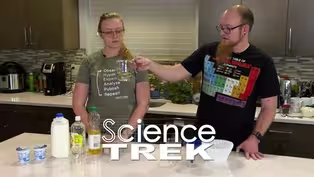
Most of the world measures things using the metric system. Learn more about this standard of measurement and how it is getting more and more accurate.
Problems playing video? | Closed Captioning Feedback
Problems playing video? | Closed Captioning Feedback
Science Trek is a local public television program presented by IdahoPTV
Major Funding by the Laura Moore Cunningham Foundation and the Idaho National Laboratory. Additional Funding by the 360 Immersive, the Friends of Idaho Public Television and the Corporation for Public Broadcasting.
Measure: The Metric System Explained
Special | 4m 56sVideo has Closed Captions
Most of the world measures things using the metric system. Learn more about this standard of measurement and how it is getting more and more accurate.
Problems playing video? | Closed Captioning Feedback
Where to Watch Science Trek
Science Trek is available to stream on pbs.org and the PBS app.
Science Trek
Science Trek is a place where parents, kids, and educators can watch short, educational videos on a variety of science topics. Every Monday Science Trek releases a new video that introduces children to math, science, technology, engineering, and math (STEM) career potentials in a fun, informative way.More from This Collection
Learning the rules is a fundamental part of playing a game. The same is true of understanding science. We need to know the basics of how things operate to begin to understand the world around us. From simple machines to states of matter, science fundamentals give us a good understanding upon which we can build. Start with the basics. Start with Science Fundamentals.
Simple Experiments with Simple Machines
Video has Closed Captions
Experiment with simple machines. (5m 32s)
States of Matter: What’s the State of Things?
Video has Closed Captions
What are the states of matter? (4m 22s)
States of Matter: Rethinking Chips
Video has Closed Captions
How do scientists use the states of matter to create new inventions? (5m 27s)
Force and Motion: Force Makes the World Move
Video has Closed Captions
Find out more about Sir Isaac Newton’s laws of force and motion at the amusement park, Silverwood. (4m 7s)
Force and Motion: Force and Motion Rule!
Video has Closed Captions
Scientists need to understand the laws of Force and Motion to travel in space. Why? (6m 10s)
Light and Color: Hidden in Plain Light
Video has Closed Captions
Color is determined by a wavelength, your eyes, and your brain. (4m 39s)
Light and Color: Use Color to Pop a Balloon
Video has Closed Captions
Can you use a laser to pop some balloons and not others? (4m 15s)
Providing Support for PBS.org
Learn Moreabout PBS online sponsorshipJoan Cartan-Hansen, Host: The French developed the metric system of measurement.
Find out how it measures up.
[MUSIC] Back in the late 17 hundreds, the people of France had a problem.
The system of measuring weights and determining length differed from town to town.
And without a uniform standard of measurement, it was hard to trade goods or build things.
This was actually a problem around the world, but the French Academy of Science decided to do something about it.
And they started with length.
[NEWSREEL MUSIC] Male voice: Length.
Cartan-Hansen: The French decided the unit of measurement of length should be based on the Earth.
More specifically, one ten-millionth of the distance between the North Pole and the equator.
They made a bar of platinum and that became the meter.
They also decided lengths larger and smaller than a meter should be measured on the decimal or base 10 system.
So, a decimeter would be one tenth of a meter.
A centimeter would be one-hundredth of a meter and a millimeter one thousandth of a meter.
And getting larger, a dekameter would be ten meters, a hectometer would be 100 meters, a kilometer would be one thousand meters.
Once they figured out length, then they decided to work on mass or weight.
[NEWSREEL MUSIC] Male voice: Weight Cartan-Hansen: In the metric system, mass, or what we more commonly call weight, is measured by the gram.
Like the meter, grams increase and decrease in the same decimal system.
So, a milligram would be one thousandth of a gram and so on.
Once they decided what a gram would be, they created a platinum object that weighed one kilogram or a thousand grams, and called it "big k."
[NEWSREEL MUSIC] Male voice: Volume.
Cartan-Hansen: The liter is a unit of measurement for liquids.
A liter is one cubic decimeter or one thousand cubic centimeters.
One liter of liquid water is almost one kilogram of weight.
Solid volumes are measured in cubic meters.
And, like other standards in the metric system, the amounts go up and down based on 10.
[NEWSREEL MUSIC] Male voice: Temperature.
Cartan-Hansen: In the metric system, temperatures are recorded using the Celsius scale, where 0 degrees is the point where water freezes and 100 degrees is when water boils.
So, most of the world has adopted the metric system.
Only the United States, Liberia, and Myanmar have held out.
Why?
Well, it costs money to change, and people don't like change; lots of reasons.
But the reality is the U.S.
standards of measurement is already based on the metric system.
That's because officially, one pound is legally defined as 0.45359237 kilograms and a foot is defined as 0.3048 meters.
And that's because standards of measurement need to be based on an agreed standard, like a meter bar or a big k kilogram.
So the metric system works.
Until scientists realized that these physical metal of standards were actually losing mass.
Oops!
So, to make these more precise, scientists changed these standards to unchanging properties of the universe.
A meter is now redefined as the distance light travels in a vacuum in 1/299,792,458th of a second.
And the kilogram is defined on the value of a thing called the Planck constant, which describes how the tiniest bits of matter release energy in chunks called quanta.
Don't worry about what all of that means.just know the kilogram is now a constant.
And having a consistent and accurate standard of measurement means we can have better science, fair trade, reliable building, and just the right amount of a snack.
If you want to learn more, check out the Science Trek website.
You'll find it at Science Trek dot org.
[MUSIC] Announcer: Major funding for Science Trek is made possible by the Laura Moore Cunningham Foundation, helping Idahoans reach new heights for generations; additional funding is provided by the Idaho National Laboratory, mentoring talent and finding solutions for energy and security challenges; and by contributions to the Friends of Idaho Public Television from viewers like you, thank you.
Measure: Beard-Seconds and Mega-Fonzies
Video has Closed Captions
Clip: Special | 1m 4s | What is your Mega-Fonzie rating? (1m 4s)
Video has Closed Captions
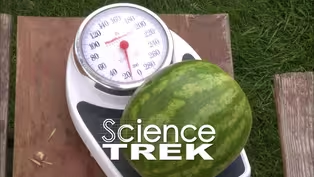
Clip: Special | 1m 4s | Mass and weight are different. (1m 4s)
Providing Support for PBS.org
Learn Moreabout PBS online sponsorship New Episode
- Science and Nature

Explore scientific discoveries on television's most acclaimed science documentary series.



 New Season






Support for PBS provided by:
Science Trek is a local public television program presented by IdahoPTV
Major Funding by the Laura Moore Cunningham Foundation and the Idaho National Laboratory. Additional Funding by the 360 Immersive, the Friends of Idaho Public Television and the Corporation for Public Broadcasting.