
Measure: Measure What?
Special | 6m 28sVideo has Closed Captions
How and why do we measure?
Measuring is way of allowing us to make comparisons and to organize our world. But it has taken us a long time to agree on how to measure things. Find out the history or measurement and more about the U.S. Customary standards.
Problems playing video? | Closed Captioning Feedback
Problems playing video? | Closed Captioning Feedback
Science Trek is a local public television program presented by IdahoPTV
Major Funding by the Laura Moore Cunningham Foundation and the Idaho National Laboratory. Additional Funding by the Friends of Idaho Public Television and the Corporation for Public Broadcasting.
Measure: Measure What?
Special | 6m 28sVideo has Closed Captions
Measuring is way of allowing us to make comparisons and to organize our world. But it has taken us a long time to agree on how to measure things. Find out the history or measurement and more about the U.S. Customary standards.
Problems playing video? | Closed Captioning Feedback
Where to Watch Science Trek
Science Trek is available to stream on pbs.org and the PBS app.
Science Trek
Science Trek is a place where parents, kids, and educators can watch short, educational videos on a variety of science topics. Every Monday Science Trek releases a new video that introduces children to math, science, technology, engineering, and math (STEM) career potentials in a fun, informative way.More from This Collection
Learning the rules is a fundamental part of playing a game. The same is true of understanding science. We need to know the basics of how things operate to begin to understand the world around us. From simple machines to states of matter, science fundamentals give us a good understanding upon which we can build. Start with the basics. Start with Science Fundamentals.
Simple Experiments with Simple Machines
Video has Closed Captions
Experiment with simple machines. (5m 32s)
States of Matter: What’s the State of Things?
Video has Closed Captions
What are the states of matter? (4m 22s)
States of Matter: Rethinking Chips
Video has Closed Captions
How do scientists use the states of matter to create new inventions? (5m 27s)
Force and Motion: Force Makes the World Move
Video has Closed Captions
Find out more about Sir Isaac Newton’s laws of force and motion at the amusement park, Silverwood. (4m 7s)
Force and Motion: Force and Motion Rule!
Video has Closed Captions
Scientists need to understand the laws of Force and Motion to travel in space. Why? (6m 10s)
Light and Color: Hidden in Plain Light
Video has Closed Captions
Color is determined by a wavelength, your eyes, and your brain. (4m 39s)
Light and Color: Use Color to Pop a Balloon
Video has Closed Captions
Can you use a laser to pop some balloons and not others? (4m 15s)
Providing Support for PBS.org
Learn Moreabout PBS online sponsorshipJoan Cartan-Hansen, Host: Measuring is a way of finding sizes or amounts.
It allows us to make comparisons.
But why, what and how we measure is quite a story.
[MUSIC] Some scientists think that the very first signs of humans measuring something can be found in the paintings in caves in France.
The images on the walls in the caves date back to prehistoric times.
Some scientists suggest the black dots along with the other images were a way to measure time through the lunar cycle.
One of the oldest known standards of measurement comes from ancient Egypt.
It was called a cubit.
It was measured from the tip of the finger to the elbow.
But there was a problem with that.
Can you see it?
To avoid confusion, an Egyptian king set the official length of a cubit and all cubits in the land had to be the same.
Cubit measuring sticks were handed out and if you didn't use it properly, the penalty could be death.
So, with a unit of measurement that was always the same, the Egyptians went on to build some of the world's most amazing structures.
Ancient Chinese kings based measurements of length on body parts too, As did English kings.
An inch became the width of a thumb, A foot was the length of a foot.
A yard was the length of a man's stride.
And, as people moved around the world and traded goods, standards of measurement went with them.
But there was still a problem.
The standard of measurement differed from country to country, even city to city.
We needed to be able to make comparisons and we needed to bring order to our world.
And you can't do good scientific research or properly build things or even know if you're paying the right amount for something if you don't have an accurate and standardized systems of measurement.
And without accurate systems of measurement, you can't predict or estimate supplies or figure out what will happen.
So, starting about 1799, the French developed the metric system.
And in 1875, established an international organization to make sure weights and measurements were accurate and the same across the world.
The English standardized their imperial system a few years earlier But America didn't start standardizing its own U.S.
customary measurement systems until the early 19 hundreds.
So, what do we measure?
Almost everything.
And how we do it, is with units of numbers based on some property, like how big or how many.
So, let's learn about some fundamental units.
Roll 'em.
[NEWSREEL MUSIC] Male voice: Time.
Cartan-Hansen: Time started out being measured by the movement of the Earth.
A year is how long it takes the Earth to make one complete rotation around the Sun.
A month is roughly how long it takes the Moon to complete one orbit of the Earth.
A day is how long it takes the Earth to complete one turn on its axis.
Ancient Egyptians divided the day into approximately 24 hours using sundials.
An hour has 60 minutes, And a minute has 60 seconds.
But how long is a second?
To be precise, a second is now not based on the movement of the Earth but on atomic time.
So what does that mean?
Well, unless you are a scientist who needs that kind of precision, don't worry about.
Just remember that seconds turn into minutes, minutes turn into hours, hours turn into days, days turn into weeks, weeks turn into months, months turn into years.
[NEWSREEL MUSIC] Male voice: Length or distance.
Cartan-Hansen: In the U.S.
customary system of measurement, don't worry about the metric system-I'll get to that in a minute- Length is measured in inches, feet, yards, and miles.
Speed limits for cars, for example, are measured in miles per hour.
That's because speed is measured in distance traveled over time.
Some distances are so vast that measuring in miles is confusing.
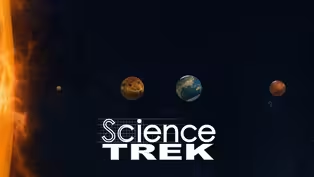
So, in space, we measure in astronomical units and light-years.
The Earth is 93 million miles from the Sun.
That's one astronomical unit.
So, Mars, for example, is 1 point 5-2 astronomical units from the Sun.
A light-year is how far light travels in one year.
A light-year is 60 thousand astronomical units.
The Sun's closest star is Alpha Centauri and it is 4 point 4 light years away.
Once you know how to measure length, you can measure height, How tall, and width, how wide.
And once you know length, height, and width, you can figure out volume.
[NEWSREEL MUSIC] Male voice: Volume.
Cartan-Hansen: Volume is a measure of space, whether it be a solid, liquid or gas.
You can measure the space to figure out the volume.
Liquid volume is often measured in ounces, cups, pints, quarts, and gallons.
[NEWSREEL MUSIC] Male voice: Weight.
Cartan-Hansen: In the United States, mass, or more commonly what we call weight, is generally measured in ounces, pounds, or tons.
And under the English system, weights are also measured in stones.
[NEWSREEL MUSIC] Male voice: Temperature.
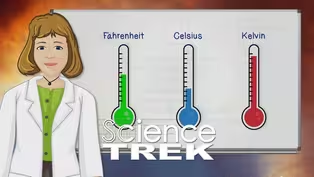
Cartan-Hansen: In the United States, temperature is measured on the Fahrenheit scale, where 32 degrees is the point where water freezes and 212 degrees is when water boils.
And that's just part of the story of measurement.
We measure lots of different things in lots of different ways.
We use comparisons and we try to bring order to our world.
And when we measure, we use units or standards of measurement.
We try to make those standards as accurate and as consistent as possible.
If you want to learn more check out the Science Trek website.
You'll find it at sciencetrek.org [MUSIC] Announcer: Major funding for Science Trek is made possible by the Laura Moore Cunningham Foundation, helping Idahoans reach new heights for generations; additional funding provided by the Idaho National Laboratory, mentoring talent and finding solutions for energy and security challenges; and by contributions to the Friends of Idaho Public Television from viewers like you, thank you.
Measure: The Small and The Big
Video has Closed Captions
Clip: Special | 1m 4s | What is a light-year? (1m 4s)
Measure: What's the Temperature?
Video has Closed Captions
Clip: Special | 1m 4s | How cold is absolute zero? (1m 4s)
Providing Support for PBS.org
Learn Moreabout PBS online sponsorship New Episode
- Science and Nature

Explore scientific discoveries on television's most acclaimed science documentary series.



 New Season





Support for PBS provided by:
Science Trek is a local public television program presented by IdahoPTV
Major Funding by the Laura Moore Cunningham Foundation and the Idaho National Laboratory. Additional Funding by the Friends of Idaho Public Television and the Corporation for Public Broadcasting.