
The Iran war's unexpected critics
Clip: 7/24/2026 | 16m 34sVideo has Closed Captions
The Iran war's unexpected critics
As the Iran war is escalating, a chorus of criticism is growing louder, and it’s coming from unexpected voices. The panel discusses some of the frustration from Republican lawmakers, voters and conservative media.
Problems playing video? | Closed Captioning Feedback
Problems playing video? | Closed Captioning Feedback
Major funding for “Washington Week with The Atlantic” is provided by Consumer Cellular, Otsuka, Kaiser Permanente, the Yuen Foundation, and the Corporation for Public Broadcasting.
The Iran war's unexpected critics
Clip: 7/24/2026 | 16m 34sVideo has Closed Captions
As the Iran war is escalating, a chorus of criticism is growing louder, and it’s coming from unexpected voices. The panel discusses some of the frustration from Republican lawmakers, voters and conservative media.
Problems playing video? | Closed Captioning Feedback
Where to Watch Washington Week with The Atlantic
Washington Week with The Atlantic is available to stream on pbs.org and the PBS app.
Buy Now
10 big stories Washington Week covered
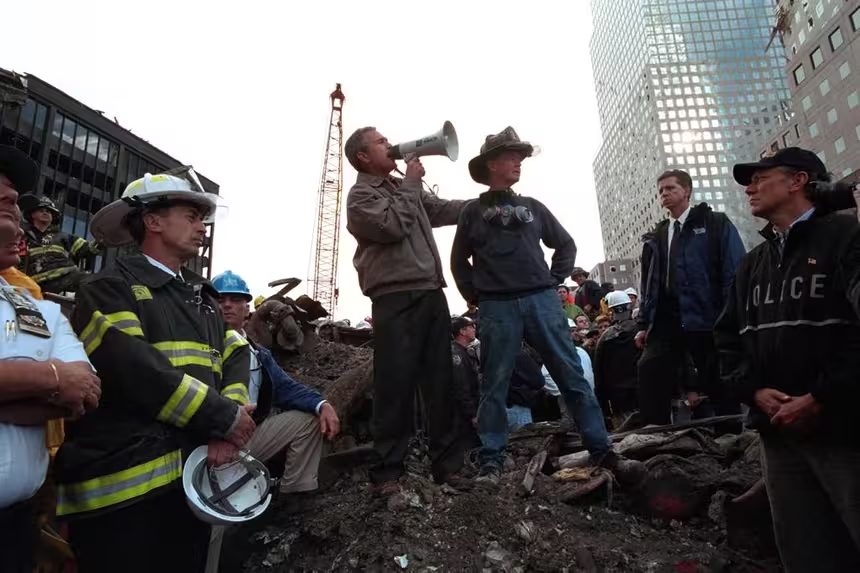
Washington Week came on the air February 23, 1967. In the 50 years that followed, we covered a lot of history-making events. Read up on 10 of the biggest stories Washington Week covered in its first 50 years.Providing Support for PBS.org
Learn Moreabout PBS online sponsorshipThis week, Secretary of Defense Pete Hagath was on the hill testifying before Senate Appropriations.
Watch this um exchange with Republican Senator uh from Louisiana, John Kennedy.
This is serious as four heart attacks and a stroke.
Will they straight?
I sir, that's a hypothetical question and I don't know the answer to that.
We need some hard answers and some straight talk.
would they try to uh to to redevel uh commence development again of a nuclear warhead?
Um part of the reason President Trump had to have the courage to do what he did after Midnight Hammer is that they didn't give up their ambitions even though their nuclear sites had been obliterated.
So this is a regime hellbent on nuclear ambitions and President Trump will go after we need straight answers.
Leanne, talk us through some of the Republican frustration.
Yeah.
Well, first, the fact that that frustration is coming from Senator John Kennedy, not someone who is usually highly critical of this administration, is very notable.
Um, he is quite frustrated and he is expressing the frustration that many of his colleagues are and that is a lack of answers from this administration on what the objective is, what the timeline is, what the ramifications are, and what the end game actually is.
And those are things that they haven't been able to get from this administration.
Even when it comes to the funding requests, there's still lots of questions about what the money is going to be used for, how much specifically is needed, how much will be needed in the future.
And so when members of Congress are asked to fund billions and billions of dollars when their constituents are the ones who are being put on the line for this, um, uh, patience obviously wears quite thin.
But I will say it is not manifesting in a rebuke to the president.
Um the House did rebuke the president this week in an a war powers resolution.
Um uh they had the help of enough Republicans, but the Senate rejected it.
And most of the Senate senators who have been really skeptical and nervous about this war are saying, "Look, the clock, the 60-day clock just restarted after the ceasefire broke.
We're going to give the administration some more time."
So there is a real dichotomy of what's happening on the hill, but there that tension is absolutely there.
And with all of these challenges, I mean, Adam just outlined many of them.
Uh midterms are now looming.
And how are these lawmakers going to go onto the campaign trail and message this, especially Republicans?
What's the messaging strategy?
Yeah, so the House has now left town for over a month.
Um they left town.
they voted to uh on a on an outline to give about $70 billion uh for the war.
It's mostly they say their justification is this is for the troops, this is to replenish munitions.
Um but they are going to face constituents as uh polling has continued to show that this war is increasingly unpopular, including among Republicans.
Um especially as prices are not going down, especially as this war has restarted again.
And so Republicans especially have a really difficult task at hand.
They um are trying to justify the spending of the war, like I said again, that it is for the troops, that it is necessary to keep our military strong.
Um but their constituents care about costs right now.
And I ask Republicans, what are you hearing from people at home?
And they admit that that is exactly what people are talking about.
I mean, the the messaging from the White House, from the president, is we can never let Iran have a nuclear weapon.
That's for we have that's why we have to do this.
But that is clearly not broken through uh to American voters, right?
I mean, we saw a poll this week, I think it was 29% support for this war uh which translates into a significant portion of the Republican base not sold on that argument.
How do you sell the American people on that argument when you have said that their nuclear program is obliterated?
Yeah, you took the words out of my mouth.
They've gone back and forth on this issue and when he sets answers, well, we found out they didn't give up their nuclear ambitions.
Well, lots of, you know, groups have ambitions to do lots of things.
So, they don't have the capability to do so.
How does that justify a war and then a renewed war?
I think there's two there are two built-in assumptions here I think John struck on that the president's making.
One is that if you don't support the war, you support Iran getting a nuclear weapon.
Well, there are lots of ways to deter countries from getting nuclear weapons.
We stopped South Africa, South Korea, Taiwan, the list is long without going to war.
But I think the the second piece of this that is remarkable is the president himself acknowledges that the June bombing last year [snorts] so buried most of their nuclear fuel that he said, "I'm not that worried about Well, if he's not that worried about it, then why does he believe that if we give up what we're doing now for a while and monitor this that they're necessarily going to get a nuclear weapon?
What's the answer?
The answer is they actually the Iranians have not been able to get at that fuel since the bombing in June of 2025.
Now, do you need to watch it like a hawk?
Absolutely.
But if with no fuel, you can't make the weapon.
But the renewed the renewed military operations here actually aren't about the nuclear issue.
They're about opening up the straight of Hormuz which was open before the war started.
Which was open before the war started.
I mean, Adam, all of these issues said, all of this said, uh, the frustration isn't just from voters.
It's not just from Republican lawmakers.
You're even seeing it from certain media commentators that are essentially, you know, allied with the president or conservative.
We played some of that the sound earlier.
talk to us a little bit about the dynamics there and how much of it influences the president's decisions when he hears Fox News now coming out and criticizing some of these decisions.
Well, you know, one of the features of the last of both administrations is that the president watches a lot of TV that he watches what people um are saying about him.
And you know, I think a lot of this comes out of the fact that the president sort of preached this isolationist um America first message.
And when twothirds of Republican voters are saying, well, we blame or two-thirds of of of voters are saying that, well, we blame the Republican party for this kind of increase in gas prices, for the increase of our our daily household things.
I think that that um that is filtering into the comment period.
It's it's filtering into the people who are saying, "Well, we're going over here.
We're spending all of this money.
Troops are dying for what?
For our um for for us to in we have people who are homeless.
We have we have all of these issues that we need to solve here in and um on in American soil that we're we're giving resources and sending resources towards something that as you both have mentioned right it doesn't have a necessarily defined objective at the moment and where the president continues to try to um create this narrative uh that he has sort of a control over the situation where um you know events show that there's not necessarily that that control over it.
So David what now?
I mean, does the president double down or does he cut and run?
I what what are the options?
What are the best options?
So, there are moments where you have seen President Trump cut and run.
He negotiated with North Korea in his first term.
Didn't go anywhere.
The North Koreans now have 60 plus nuclear weapons.
He hasn't mentioned it, right?
Barely mentioned it in in recent times.
But he's passed the moment where he can leave this because with the energy prices going up, with the straits closed, now with a second uh front opening up around the Red Sea, he's in a position where if he just pulled out now, the world economy and the world energy supplies would be in a far worse place than they were when he started.
And so that makes it hard to sort of declare victory.
I could imagine he's tried.
I mean, he really tried to disengage.
He really tried to get at this.
He dispatched his vice president to have the highest level negotiations that we've have had with the Iranians since the revolution.
And he offered terms, agreed to terms that were, you know, incredibly generous to the Iranians.
He wanted to declare victory and leave.
The problem was the Iranians didn't go along with it.
Right.
Leanne, we talked so much about President Trump's fixation this term on his legacy and, you know, how people are going to talk about him in the future.
Do you get the sense that he's concerned about how the Iran war will impact his legacy or is it more of a case and, you know, especially from folks you talk to on the Hill, do they feel like he thinks that everyone else is wrong and he was right about this?
So, I think legac legacy is absolutely number one on his mind.
Um, and the people who cover the White House might have more insight on this than me, but um, my understanding is actually when it comes to his legacy, he thinks that the Iran war is part of his legacy and that he has it has to turn out well.
What is not part of his legacy is who wins which party takes control of the mid after the midterms and he is not focused on that.
And that is what is expressly frustrating for members of Congress and people whose names are on the ballot where the president is completely uh captivated by these international conquests essentially.
Um when people at home that's not what their priority is.
I was talking to a person who was very close to the administration this morning about the politics of it and I said what do you worry about heading into November?
and they said, "Well, um, the war, I try not to worry about it because that's completely out of my control, but if this is not wrapped up very soon, this is going to be very difficult for Republicans."
And so, I think when it comes to the president's legacy, you see it all across town, um, with the building, um, with what he is doing internationally, um, and politically, he thinks he's already won that legacy.
So, interesting.
There were um there was another major headline that came out of the Middle East this week where the administration signed a landmark deal to develop a civilian nuclear program in Saudi Arabia using predominantly American technology.
But hours after it was signed, President Trump took to Truth Social and essentially uh backtracked on it, saying that it was all contingent upon Saudi Arabia joining the Abraham Accords and normalizing ties with Israel.
So David, um, you know, this deal has actually been met with a lot of criticism, including from conservatives.
So explain exactly what's happening here.
So this negotiation has been going on since the first Trump administration.
It proceeded through the Biden administration.
And in some ways, it's a very standard thing.
It's bringing American technology to build nuclear power plants for electricity production.
The Saudis like the UAE and others who have nuclear power plants.
The Saudis would like to have data centers.
They want to modernize their economy.
So, it all makes perfect sense.
But the Saudis did not want to sign on to some of the non-prololiferation agreements that the UAE, the United Arab Emirates did in 2009 with President first negotiated by President Bush, then negotiated by President Obama.
And so when the president finally got this deal together, it was announced by Secretary of Energy Chris Wright, uh, and it was signed by his equivalent in Saudi Arabia.
And the next morning, the president blows the whole thing up by saying, "Well, of course, this is not going to go forward if the Saudis don't recognize Israel," which had been the Biden plan.
Right.
Right.
I mean, Adam, he's basically negotiating it in public after it's signed.
Yeah.
How does that work?
Yeah, I mean it it feels like a sort of MMO uh for the president, right?
It's it's a negotiation through through posting.
Um and I think uh early on in that first administration, right, I actually wrote a sort of history of of the president's use of of Twitter at the time and now X and it's it's functionally been how he has operated.
It's how he communicates with people.
And so when he sees that, well, there's a little bit of push back, it's it's his way of communicating, well, there's actually um there's there's another tweak, right?
it's contingent upon something that that we want.
It doesn't look as if um Saudi Arabia got everything that it wants and you know the United States didn't get what it wants and Israel um sort of its partner didn't get what it wanted as well.
Right.
And before uh before we wrap up you this week uh was the last week before the Hill you mentioned Leanne goes uh goes on a vacation and then ultimately they're going to have midterms to contend with.
Um they call it kitchen sink week because they try to throw in everything in the kitchen sink.
How did that go, Leanne?
first of all um and secondly just talk to us about the dynamic of uh politics on Capitol Hill going into these crucial months before the midterms.
Yeah.
So the House actually had a very successful week.
Um Speaker Mike Johnson got everything that he wanted to get done done, including a very limited stock trading ban.
Um you know, funding a short-term funding bill that funds until after the midterm elections.
um uh this reconciliation partyline framework um that funds the war um and uh some a programs etc.
So he had a really successful week after weeks and weeks and weeks of nothing moving on the house floor.
So it was it was good for him but that doesn't mean these things come become law.
Um there these things have to pass the senate.
There's a lot of push back in the senate.
The dynamics are extremely difficult and much more complicated in the Senate.
You have a growing number of Senate Republicans who are extremely worried about their own reelections or mad at the president and not willing to fall in line.
Um, and so there's a lot of unease about the midterms, um, and all these political dynamics, a lot of frustration with the president, and, uh, members are heading home and having to deal with the anger of constituents, too.
So, it's it's a tricky time um, for Republicans despite this these like minimal wins that they got this week.
And John, President Trump has his own frustrations.
is Carolyn Levit, the White House press secretary, said this week that he was frustrated with Majority Leader John Thun.
Can you explain what's happening there?
Yeah, the president went after Thun in his speech in Georgia.
I mean, pretty directly.
Uh, look, the the the president has been pushing for a long time and this goes back to his first term and frustration he expressed with Mitch McConnell.
He wants the filibuster done with so a Republican majority, even a really narrow Republican majority majority can push anything it wants uh through the Senate.
and he's insisting that Dun do this and Thun has tried to explain privately and publicly that there aren't the votes to change the Senate rules.
You need a majority of the Republicans to do that and there is nowhere near that level of support.
So I think this is a very interesting dynamic to watch forward because the president's frustration with Thun and his demand a demand that Thun sees as absolutely unfair and and untenable um continues and I think you're going to you're going to see that clash more and more.
Meanwhile, you know, Thun's trying to get uh Republican senators reelected in uh you know in in races that are going to be tough, right?
And Adam, in the minute we have left, you know, the president obviously standoffish on elections, but very much involved in trying to kind of hold push push the push the House and the Senate uh on legislation.
You know, how do how does you get the split screen dynamic between what he's doing on their politics and what he's doing on legislation?
you know, I if you follow from, you know, thinking things like endorsing against John Cornin down in Texas, things that would would upset the the [snorts] Senate um majority, but then also things like going out to Michigan.
He's planning to go to Michigan next week um to to campaign for um Mike Rogers.
And so like just thinking I I think that the president believes that if he is successful on Iran, if he can sort of project success on Iran um and say you know things like the war will be over very soon, then uh then things will turn in his favor um that the the party will come around uh to sort of his policy goals as long as he sort of continues SL.
The mounting cost of the Iran war
Video has Closed Captions
The mounting cost of the Iran war (6m 54s)
Providing Support for PBS.org
Learn Moreabout PBS online sponsorship New Episode
- News and Public Affairs

Top journalists deliver compelling original analysis of the hour's headlines.

- News and Public Affairs

FRONTLINE is investigative journalism that questions, explains and changes our world.


 New Episode
 New Episode
 New Episode

 New Episode
 New Episode
Support for PBS provided by:
Major funding for “Washington Week with The Atlantic” is provided by Consumer Cellular, Otsuka, Kaiser Permanente, the Yuen Foundation, and the Corporation for Public Broadcasting.