
Strike on Iran: The Nuclear Question (2025)
Clip: Season 2025 Episode 17 | 54m 23sVideo has Closed Captions
An investigation of Iran’s nuclear program in the aftermath of the U.S. and Israeli strikes.
Using rare on-the-ground access in Iran and in-depth forensic analysis, FRONTLINE, The Washington Post, Evident Media and Bellingcat conduct an immersive investigation of Iran’s nuclear program in the aftermath of the U.S. and Israeli strikes.
Problems playing video? | Closed Captioning Feedback
Problems playing video? | Closed Captioning Feedback
Funding for FRONTLINE is provided through the support of PBS viewers and by the Corporation for Public Broadcasting. Major funding for FRONTLINE is provided by the Ford Foundation. Additional funding...
Strike on Iran: The Nuclear Question (2025)
Clip: Season 2025 Episode 17 | 54m 23sVideo has Closed Captions
Using rare on-the-ground access in Iran and in-depth forensic analysis, FRONTLINE, The Washington Post, Evident Media and Bellingcat conduct an immersive investigation of Iran’s nuclear program in the aftermath of the U.S. and Israeli strikes.
Problems playing video? | Closed Captioning Feedback
How to Watch FRONTLINE
FRONTLINE is available to stream on pbs.org and the free PBS App, available on iPhone, Apple TV, Android TV, Android smartphones, Amazon Fire TV, Amazon Fire Tablet, Roku, Samsung Smart TV, and Vizio.
Buy Now
"Who Am I, Then?"
Explore this interactive that tells the stories of over a dozen Korean adoptees as they search for the truth about their origins — a collaboration between FRONTLINE and The Associated Press.Providing Support for PBS.org
Learn Moreabout PBS online sponsorship>> Iran’s key nuclear enrichment facilities have been completely and totally obliterated.
>> We’ve taken out their senior technologists who are leading the race to build atomic weapons.
>> NARRATOR: In collaboration with the Washington Post, Evident Media, and Bellingcat, correspondent Sebastian Walker investigates the aftermath-- >> Woah, it’s still falling down.
>> Yeah.
>> NARRATOR: With rare access, on the ground-- >> Did you know who was living there?
>> (speaking Farsi): >> NARRATOR: Forensic analysis-- >> If they had penetrated the halls it would have been catastrophic.
>> NARRATOR: And high level interviews.
>> We assess that the elimination of all major nuclear scientists in Iran is a major setback for the project.
>> What’s your assessment of the extent this has set back Iran’s nuclear program?
>> (speaking Farsi): >> NARRATOR: Now on FRONTLINE-- >> The determination was and still is, that the damage was very substantial.
>> NARRATOR: Strike On Iran: The Nuclear Question.
♪ ♪ (objects clattering) (phone camera clicks) >> SEB WALKER: I'm in Tehran, at a spot where, weeks ago, a top Iranian nuclear scientist was assassinated in an Israeli strike.
♪ ♪ (sirens blaring) The blast took out the side of this building.
It was one strike in an unprecedented U.S.
and Israeli air campaign.
>> We were facing an imminent threat, a dual existential threat.
>> WALKER: Hundreds of munitions launched in the span of days, aiming to cripple Iran's nuclear program.
♪ ♪ >> Iran's key nuclear enrichment facilities have been completely and totally obliterated.
>> (speaking Farsi): >> WALKER: Iran fired back, launching barrages of ballistic missiles and drones into Israel.
(explosions pounding) I've reported from Iran before, and foreign journalists, especially, are always closely monitored.
This time, it's even more so.
The government is tightly controlling where we go and who we can talk to, but it's a chance to see some of the damage up close... (sirens blaring) ...to sit down with top officials... How much has this set back Iran's nuclear program?
>> (speaking Farsi): >> WALKER: ...and to try to understand the scale of the operation and the question of what it left behind.
♪ ♪ (traffic humming in distance) (person exclaims, traffic humming in distance) ♪ ♪ (man chanting, people talking in background) It's Friday prayer at the Tehran University campus.
(man chanting in Farsi) The imams here are handpicked by Iran's supreme leader, Ayatollah Ali Khamenei, and they echo his message: that the 12-Day War in June didn't devastate the country's nuclear program, as the U.S.
and Israel have stated.
>> (speaking Farsi): >> WALKER: Instead, they say, the bombing has drawn Iranians closer together and hardened their resolve against their mortal enemies.
>> (speaking Farsi): (man calling in Farsi) >> CROWD (shouting in Farsi): (shouting in Farsi): >> WALKER: We've been given permission to film here, accompanied by our minders.
It's the kind of scene that Iran's hardline theocratic government often wants to project to the outside world.
But halfway through the sermon, we're told we have to leave, a sign of the constant challenges we'll be facing.
♪ ♪ My journey started two weeks earlier, in the newsroom of "The Washington Post."
Given the limitations of working inside Iran, we partnered with the "Post's" visual forensics team to help guide the reporting on the ground, and we worked with investigative journalists from nonprofit outlets Bellingcat and Evident Media.
The team has been poring over satellite imagery to understand from afar the impacts of the strikes and how much the nuclear program has been set back.
Nilo Tabrizy speaks Farsi, and has been combing social platforms accessible in Iran for images and video of the locations that were hit.
We've been told we could get access to the site of an assassination and also speak to family members of a, of a killed scientist.
>> That would be really helpful to us, because we were only able to confirm about five of these names with their locations.
I think we've gotten close to exhausting what we can do from afar, and this is really where the field reporting is gonna come in handy.
♪ ♪ >> WALKER: Eric Rich is the "Post's" deputy investigations editor.
Good to see you.
>> Good to see you.
>> WALKER: Thank you.
>> Have a seat.
I mean, it would be great if we could coordinate while you're there.
As you start to get a sense of, like, which scientists' families you might be able to talk to, let us know immediately, and we can start to build sort of a dossier around that strike.
Also, if anybody is able to share photos that they may have in their phones from immediately after, that would obviously be of even greater interest.
>> WALKER: So sending pictures back, sending videos back, that's something that's, that's helpful... >> That would be hugely helpful, and we can, in real time, we can analyze them and try to, you know, understand if we can draw some conclusions or inferences that might shape questions, further questions that you can ask.
♪ ♪ >> WALKER: Prior to the strikes, the International Atomic Energy Agency had said that Iran had increased its stockpile of near-weapons-grade enriched uranium, though hadn't found evidence of a systematic nuclear weapons program.
But Israel believed Iran was just a short step away from producing a nuclear bomb, which they saw as an existential threat.
♪ ♪ They seized the moment.
>> We're hearing a statement from Israeli Prime Minister Benjamin Netanyahu.
>> Moments ago, Israel launched Operation Rising Lion to roll back the Iranian threat to Israel's very survival.
(explosion pounds) >> In and around the capital, Tehran, Israeli targets seem to be expanding.
>> The Iranians acknowledging that some of their senior military leaders have been killed or wounded.
♪ ♪ >> WALKER: The first wave of attacks hit nuclear facilities, military targets, and apartment blocks in Tehran.
Our government minders have brought us to one of the locations that was hit, a building we're told is known as the "Professors' Complex," since many academics live here.
♪ ♪ We're shown around by Iraj Rasooli, a microbiologist, and his relative Hanieh.
(debris bangs) Whoa, it's still falling down.
>> Yeah.
Just be careful, huh?
>> WALKER: Yeah.
>> Sixth floor was hit.
Where we are standing is third floor.
>> WALKER: Okay.
>> Four, five, and one above that, six.
From ninth floor to third floor, 100% destruction.
I was sleeping there.
That was my bedroom.
My elder daughter was sleeping here, younger daughter was sleeping there.
So when I went to help her brother, he was thrown from his bed, here he was sleeping, to that corner.
So when I went to help him, to lift him up, so his entire skin came on my hand.
It was so bad, he was so badly burned.
>> WALKER: Rasooli says his son-in-law died.
So did his daughter and grandson.
Living three floors above them was a physics professor named Mohammad Tehranchi.
Sanctioned by the U.S.
in 2020, he was seen by Israel as a key player in Iran's pursuit of a nuclear weapon.
Did you know the person that they were targeting?
>> Yeah, yeah.
>> WALKER: You, you knew him personally?
>> I knew him, yeah, I knew him.
Yeah.
>> He knew, but he didn't know that he is an important person for the government... >> Yeah, I didn't... >> WALKER: You didn't know that he was doing this, this role in the, in the program?
>> We knew that he was a physicist, and he was chancellor of Islamic Azad University.
>> WALKER: Mmm.
>> We knew this much.
So what Israel knew more than us, that is up to them.
(chuckling): We don't know, we don't know.
♪ ♪ (phone beeps softly) >> WALKER: And so I just wanted to send a voice note.
(on phone): We're at a building in the north part of Tehran.
This is the site of one of the killings of one of the scientists.
Here on the floor below where his apartment was, and I think there are six floors that are missing here.
So the size of the munition that was used was extensive.
(men talking in background, objects clattering) (on phone): There were civilians killed alongside this scientist.
This is Dr.
Mohammad Tehranchi.
He's a professor of physics at one of the universities, and the residents here say that they didn't really have any sense that he was associated with the nuclear program.
Another strike in Tehran, less than two hours later killed a scientist named Fereydoon Abbasi, who used to head the government agency that runs Iran's nuclear program.
He had been sanctioned by the U.S.
and E.U.
and survived an assassination attempt in 2010 widely attributed to Israel.
As we travel around Tehran, we see posters of both men celebrated as martyrs.
Both Abbasi and Tehranchi were buried alongside top military commanders also killed in the Israeli strikes.
Thousands attended the funerals.
(man singing in Farsi over loudspeakers) We're given permission to visit the site of Tehranchi's grave to see if we can find out anything more about him.
Almost three months after the strikes, people are still coming to pay their respects to those killed by Israel.
We approach a man who says he comes here once a week to pray for Tehranchi.
>> (speaking Farsi): >> WALKER: Our conversations are helping the "Post" develop a picture of the importance of Tehranchi and the other scientists killed.
>> So he seems like a really critical character in this.
Do we have any sense of whether he and the others were targeted for their general expertise or, like, a specific project that they were working on that was part of the alleged nuclear program?
>> I talked about this with a few different sources, about, how important are these guys, and someone mentioned they went after older scientists.
None of these were younger people in the field.
And so this one expert said it's probably because they want to try to destroy the brain trust, like, the, you know, the people who were foundational in this.
But the other side of it is that for the past decade or so, maybe even longer, there's been a big push in Iran, apparently, to have people train and study up in, in theoretical physics and nuclear work.
>> WALKER: We repeatedly ask our minders if we can speak to relatives of the assassinated scientists, who Israel claimed were leading Iran's nuclear program.
They finally agreed to introduce us to Tehranchi's brother Amir.
So how would you describe his role in Iran's nuclear program?
>> (speaking Farsi): >> WALKER: So the U.S.
says that he played a leading role in efforts to develop a nuclear device in the mid-2000s, up to 2003.
What's your response to that?
>> (speaking Farsi): >> WALKER: So he was placed on the list of sanctions by the U.S.
government.
Were you surprised when this happened?
>> (speaking Farsi): >> WALKER: For people outside of Iran who are questioning how much these killings have set back Iran's nuclear program, how big a loss do you think it is to have his knowledge, his expertise, taken out of the equation?
>> (breathes deeply) (speaking Farsi): (traffic humming in distance) ♪ ♪ >> WALKER: Hey, I just wanted to send you a quick note, because we've just wrapped an interview with Tehranchi's brother.
When we were done, he showed me photographs that he'd taken that were on his computer.
There were what appeared to be fragments of the weapon, pieces of metal, what looked like rotors, and also, there was what appears to be a serial number.
>> S-M... >> WALKER: S-M-B... >> BOTH: A-M-S-O-O-A-A.
>> WALKER: 2008.
He didn't want to give us the originals, but we've filmed it on our camera, and I've taken screenshots that I'm gonna send to you.
Working with open-source investigators from Bellingcat, the "Post" team starts piecing together how the strikes against the scientists were carried out and looking into whether the Israelis used some kind of "special weapon," as had been reported in the Israeli media.
>> So were there, were there markings on the alleged fragments, or you, we couldn't make it out?
>> Yeah, there were some markings on there that had a possible part number and a possible lot number.
You have S-M-B-A-M-S-0-0-4-A.
But with, a lot of these databases are private from the arms company.
So it's not something we can check using open sources, especially if it's a weapon that hasn't been used before.
>> Trevor, is there anything at the strike site that allows us to glean any insight into whether this munition was fired from an aircraft or the ground?
>> So from the damage alone, the experts we talked to, they weren't able to confirm that.
It's more likely that it was a longer-range munition, like a ballistic missile or a cruise missile.
(traffic humming in distance) >> WALKER: In Tehran, we're pushing to see more strike sites.
Our minders agree to take us to where another nuclear scientist was killed.
We're told it happened within minutes of the Tehranchi strike.
The timing of the assassinations seems coordinated, so that none of the targets had time to go into hiding.
We're at another location here.
It's where the scientist called Ahmadreza Zolfaghari was killed.
A local resident told us that she heard the explosion at around 3:30 a.m., so almost the exact same time that the other strike took place.
♪ ♪ Ahmadreza Zolfaghari was the former dean of the faculty of nuclear engineering at the Shahid Beheshti research university, which was sanctioned by the E.U.
and others for links with Iran's nuclear program.
As night falls, we find a neighbor who lives across the street.
>> (speaking Farsi): >> WALKER: Which one is your house?
>> (speaking Farsi): >> WALKER: This one?
>> (speaking Farsi): (people shouting in Farsi, car alarms blaring) >> (shouting in Farsi): >> WALKER: That's from the same night?
(people shouting in phone video) >> (speaking Farsi on phone): >> (speaking Farsi): >> WALKER: It's from there, yeah.
>> (speaking Farsi): >> WALKER: Did you know who was living there?
>> (speaking Farsi): >> WALKER: Mm.
>> (speaking Farsi): ♪ ♪ >> WALKER: Over the course of several days, we're taken around Tehran to various locations where Israeli strikes had taken place.
We sent pin locations, photos, and interviews with witnesses back to the team in the U.S., who combine them with satellite imagery and geo-located video to start to piece together a bigger picture of what happened.
(phone camera clicks) ♪ ♪ It was an assault at multiple sites across the city.
The strikes started in the early hours of the morning and hit in quick succession.
Nine people Israel viewed as key to Iran's nuclear program-- scientists, engineers, physicists-- all were killed.
We are able to confirm the locations and tally civilian casualties from the strikes on Abdolhamid Minouchehr and Ahmadreza Zolfaghari, both nuclear engineering professors killed just blocks from each other.
Further east, we confirm the location and casualties from the strike on Mansour Asgari, a physics professor sanctioned by the U.S.
for alleged ties to nuclear weapons development.
And in Sa'adat Abad neighborhood, where Tehranchi was killed, witness accounts combined with images of the direction of the blast and structural damage indicate a weapon or weapons with the force of a roughly 500-pound bomb.
Taken together, it reflects an unprecedented campaign by Israel in its scale, weaponry, and impact.
>> We've already done great things.
We've taken out their senior military leadership.
We've taken out their senior technologists who are leading the race to build atomic weapons that would threaten us, but not only us.
... We've done all that and many other things, but we are also aware of the fact that there's more to be done.
♪ ♪ >> WALKER: "Washington Post" correspondent Souad Mekhennet spent time in Israel interviewing senior intelligence and military sources about the operation.
She was able to speak to a senior military intelligence official who helped plan the assassinations, which he said had been years in the making.
He let her record the meeting, but didn't want his face shown.
>> (on computer): We mapped out a group of roughly 100 scientists, and we made an extensive analysis.
We ended up with a group of the most valuable targets to be eliminated.
The second phase was developing the intelligence and operation capability to precisely strike and eliminate each one of these targets up to the level of an apartment in Tehran.
(on computer): We've made everything possible to minimize the collateral damage that is expected, and employed precise force only against targets that we thought were critical to deny Iran's pursuit of nuclear weapons.
Since knowledge is the core asset of any weaponization program, we assessed that the elimination of all major nuclear scientists in Iran is a major setback for the project.
♪ ♪ >> WALKER: A senior security official told the "Post" that Israel did use a so-called special weapon for precision strikes, against military targets but wouldn't get into details.
The official also said that they were able to track the scientists and other targets using more than one hundred local assets inside Iran.
>> So apparently, local Iranian assets played a major role in finding out where those scientists were living, if they were still active, where they were active.
This apparently is also the first time in the history of Mossad that they led an operation in a foreign country with a majority of local assets.
They said they wanted to send a message to the government in Iran, together with the American intelligence services, which was, these two would always work together in making sure that Iran would not reach a point where they could create and build a bomb.
(traffic humming) ♪ ♪ >> WALKER: One of the scientists on Israel's list escaped death that first night.
We want to go to the town where he fled, around six hours north of Tehran.
The Iranians rarely let international reporters outside the capital.
Our minders agree to take us, but they insist we stop at an airport near Karaj, a city where Iran produces centrifuges that enrich uranium.
♪ ♪ We're shown around by an airport official.
What kinds of people would be landing in those planes?
>> (speaking Farsi): >> WALKER: They claim this was a purely civilian site.
The Israeli military said they had no record of a strike here.
But the military intelligence official the "Post" spoke to said all the strikes were against high-value targets in the, quote, "nuclear sphere" and had a military objective.
(rubble clattering) Are those flight logs?
>> Log book.
>> WALKER: As we walk around, we notice our minders are filming our visit.
>> (speaking Farsi): >> WALKER: Do you have any theory as to why Israel would, would target this place?
>> (speaking Farsi): >> WALKER: No idea?
>> No idea.
>> WALKER: Days after the strike here, Karaj's centrifuge production facility was also hit.
We ask if we can go see it.
Is it possible we can go to Karaj?
>> What do you want from Karaj?
>> WALKER: It's where they say they were manufacturing the centrifuges, in Karaj.
>> No, in Karaj is a military base.
They don't let, uh, go.
>> (speaking indistinctly) >> WALKER: It's not possible?
>> It's, it needs higher coordination before.
>> WALKER: Uh-huh.
>> Yes.
♪ ♪ >> WALKER: We continue north, to the town where the scientist, Mohammad Reza Seddighi Saber, found refuge in a relative's home.
He'd been sanctioned by the U.S.
in May 2025, accused of working on projects related to the development of nuclear explosive devices.
On the last day of the war, an airstrike leveled the home with him and his relatives inside.
(jackhammers pounding) I'm standing literally overlooking the site right now.
So looks like a larger weapon than was used in those strikes on June 13.
And it was a long drive to get here.
It was, you know, around six hours from the capital.
This is a much smaller, kind of sleepy town, almost.
The arrival of local police, as well as men we're told are intelligence officers, is keeping residents far from our cameras.
But the images we're sending back give the "Post" and Bellingcat a new window into what happened here.
(sirens blaring in distance) >> So we were able to confirm this location, because the "Frontline" team visited on the ground and they sent us their coordinates.
This is a part of Iran that's not imaged quite often.
This is in Gilan province.
This right here, where I'm kind of circling my cursor, this is the site that was struck.
And then the most recent post-strike imagery was not until August 31, so a couple of months afterwards, and this empty lot is where the residences once stood.
And so the working theory from a few different experts is that perhaps two different 2,000-pound-equivalent munitions landed in this crater and then perhaps one last one here.
Um, so we were able to measure the crater size.
Believe that it was between 14 to 16 meters and seven meters.
>> When Saber was actually killed, that was at the end of the war.
So it's possible they used a different munition.
Maybe they felt more comfortable with, uh, Iranian air defense being, um, degraded.
Or maybe it was just because he was farther away from Tehran at the time that he was actually killed successfully.
>> Right, so you guys have spent some time looking at these images, the images from Iran, done some forensic analysis.
What is your sense of a takeaway?
What have we learned from that?
>> I think it's helpful to, to go back to the first wave of, or previous waves of nuclear scientist assassinations in Iran and see how this is completely different.
In the first wave of assassinations in the early 2000s, you had, you know, Mossad agents driving up on motorbikes, putting magnetic bombs on car windows.
And it was, you know, they did these targeted strikes against a few scientists.
>> And here we see an air campaign, coordinated, multiple scientists.
I mean, this feels both different in tactics and also in goal.
I think you're looking at, like, strategic degradation across the program, instead of, like, disruption at the level of an individual scientist.
♪ ♪ (car horn honks) (phone camera clicks) >> WALKER: Not far from the site is the mosque where Mohammad Reza Seddighi Saber and his relatives are buried.
Inside, our minders introduce us to someone who says he knew him.
>> (speaking Farsi): >> WALKER: It seems like he had a high position, that he was closely involved in the program.
Can you understand why he was targeted?
>> (speaking Farsi): >> WALKER: What impact do you think it will have, the fact that they were able to kill Mohammad Reza?
How is that going to affect the nuclear program?
>> (speaking Farsi): >> WALKER: We want to find out what Iranian officials have to say about these scientists Israel and the U.S.
have said were critical to the nuclear program.
The head of Iran's nuclear agency, the AEOI, agrees to meet me.
♪ ♪ Security guards don't allow us to film until we're deep inside his heavily guarded headquarters.
Mohammad Eslami oversees all the country's nuclear sites.
♪ ♪ How much has the killing of these scientists set back the nuclear program?
>> (speaking Farsi): >> WALKER: The U.S.
says the goal of the nuclear program is to produce a nuclear weapon.
What's your response?
>> (speaking Farsi): ♪ ♪ (motorbike engine running) ♪ ♪ >> WALKER: We leave Tehran and travel south, through the mountainous landscape that's home to three nuclear sites that the U.S.
and Israel say are the heart of Iran's secret weapons program, where its stockpile of near-weapons-grade uranium is believed to be produced and stored.
(people talking in background) Israel bombed the sites.
And on the tenth day of the 12-day campaign, America joined the attack.
(explosion pounds in distance) >> A short time ago, the U.S.
military carried out massive precision strikes on the three key nuclear facilities, Fordow, Natanz, and Isfahan.
>> In total, U.S.
forces employed approximately 75 precision-guided weapons during this operation.
>> Iran's key nuclear enrichment facilities have been completely and totally obliterated.
>> WALKER: As we approach Isfahan, the city closest to one of the key nuclear facilities, our minders want us to film the site of another Israeli strike.
They tell us that two cars with civilians were hit by an Israeli missile, and they've called someone they say is a witness to meet us.
>> (speaking Farsi): >> WALKER: Did you see the, the strike?
>> (speaking Farsi): >> WALKER: Is there a CCTV camera here?
>> (speaking Farsi): >> WALKER: The Israeli military told us they had no knowledge of a strike at this location.
(people shouting) ♪ ♪ We eventually arrive in Isfahan, 12 weeks since U.S.
cruise missiles slammed into the nuclear facility on its outskirts, where we're hoping to film.
The city looks different from trips we'd taken here before, with fewer women wearing the hijab, a sign of opposition that's been building for years against theocratic rule.
(bells jangling) As we wait for permission, our minders tell us we can ask people about the bombing.
But on that question, no one wants to speak.
Excuse me, do you guys speak English, by any chance?
>> Yes.
>> WALKER: Can we interview you?
>> Umm... >> WALKER: On camera?
Is it possible?
>> Um... Oh, no.
>> WALKER: Okay.
Can we talk to you on camera?
>> No problem, but... >> WALKER: Uh-huh.
>> What you ask me?
>> WALKER: About the, the 12-Day War.
>> No.
>> WALKER: Okay.
(chuckles): All right, thanks.
(people talking in background) In the end, a message comes from Tehran that we're not going to be allowed to film the damage at the center.
They claim it's not safe.
This is as close as they'll take us.
The bombed facility is just behind this ridge.
Do you think we could get a shot from that place?
>> Is a station for cable car.
>> WALKER: Mm.
For the nuclear center, could we drive close to it?
Even if we don't stop and get out?
>> Even from the car, you need permission.
>> WALKER: Even from the car?
>> Yes.
♪ ♪ >> WALKER: But away from Isfahan, my colleagues back in Washington have been piecing together what happened there and at the other nuclear sites.
Isfahan is Iran's largest nuclear complex.
The U.S.
says it launched more than two dozen precision-guided Tomahawks at the site.
Satellite imagery obtained by the "Post's" visual forensics team shows damage to the main uranium conversion facility.
>> This piece of damage is from Israeli strikes previously and then this is when the U.S.
hit the Isfahan center here, and our sources told us that this damage means that it was knocked almost completely out of operation.
>> WALKER: Isfahan is also reported to have held much of Iran's stockpile of enriched uranium.
What happened to that material is unclear.
The U.S.
says Natanz was struck by two bunker-busting bombs known as massive ordnance penetrators, or M.O.Ps.
Satellite imagery shows visible penetration points that align with underground centrifuge buildings.
Israel had also struck the electrical infrastructure here, crippling the site before the U.S.
bombs did their damage.
>> And that electricity is so key because the centrifuges are spinning at such a high rate that if the electricity is cut, the spinning will stop.
And that can compromise the structural integrity of these very delicate machines, um, such that they will spin out and, and sort of destroy themselves.
>> WALKER: Fordow took the heaviest hit.
The U.S.
focused most of its munitions here, on what it considers Iran's most important enrichment site, buried deep inside this mountain range.
The U.S.
says B-2 bombers dropped 12 M.O.Ps., most of them through two ventilation shafts.
Satellite imagery before and after the strike show two ventilation openings that appear to confirm this, but not the extent of the damage.
The team has also been able to gather information on what may have happened once the bombs penetrated underground at Fordow.
Using floor plans released after a 2018 raid by Mossad and diagrams exhibited by the Pentagon, the "Post" built a 3D model of the likely position of the underground complex and its ventilation infrastructure.
It shows the M.O.Ps.
entering above or near the areas probably used for enrichment activity.
But it suggests multiple scenarios about the possible level of damage.
A source with knowledge of the design said the center shafts of each structure zigzag on their way to the centrifuge halls below, which would mean the M.O.Ps.
could have hit additional rock.
If the M.O.Ps.
managed to penetrate to the halls, they in all likelihood would have destroyed the centrifuges and related infrastructure.
>> The M.O.Ps.
still could have undermined the centrifuges even without penetrating the interior.
If they had penetrated the halls, they would have, it would have been catastrophic.
If it were to hit from above the facility, but not inside the facility, the force of that explosion would still sort of move through the rock and rattle the facility in a way that could cause the function of the centrifuges to be undermined.
♪ ♪ >> WALKER: Regardless of the damage, it's still unclear how much of Iran's stockpile of enriched uranium was destroyed, whether it's buried under rubble in these bombed facilities, or whether at least some is in another location.
In the meantime, our colleagues at the "Post" have also begun to detect new activity at another underground facility that was not bombed.
>> (on phone message): There's something I wanted to ask you, as you're in a pretty sensitive reporting environment, so I can't explicitly say the names, but there is a site of interest that we have that was not hit by U.S.
strikes, but it's an important site.
So I just wanted to flag there has been some increased activity that we've seen on satellite imagery.
>> WALKER: The activity the "Post" has detected is at a site built inside a mountain called Kuh-e Kolang Gaz La, or Pickaxe Mountain.
On our journey back from Isfahan, the road passes close to Pickaxe Mountain.
♪ ♪ We find an excuse to stop and take pictures.
The complex is somewhere in this range, believed to be buried deeper than any of the facilities that were bombed.
♪ ♪ (message sends) >> Seb took some photos from here of Pickaxe.
>> WALKER: Our photos add to a picture the team is building on Pickaxe from satellite imagery.
>> You really get a sense of the topography there, which you kind of lose in satellite.
Part of the security infrastructure that is expected at a secure site like this would be building perimeter walls and security features that have controls what comes in and what comes out.
>> WALKER: Iran has said the purpose of Pickaxe Mountain is to house a production plant for assembling centrifuges.
>> The ability for the regime to reconstruct centrifuges is going to be important in their ability to bounce back, which puts more eyes on Pickaxe.
And if indeed there is centrifuge construction taking place there, what that means is that they would be able to come back relatively quickly.
>> WALKER: Analysts also suspect that Pickaxe's dimensions and estimated depth could be used for uranium enrichment or for storing near-weapons-grade uranium.
Using satellite imagery, the "Post" has been able to show the site is now being fortified and expanded.
>> Here, this summer, on the right-hand side, you can see the status of the, the security wall underway.
You can see them making their way through the rock.
Now, compare that here, on the left now, this fall, where you can see that security perimeter have, becoming closer to completion.
>> I think what's so interesting about this site is, it gets at this question of what's next.
And we're seeing evidence, it sounds like, of a continuation of the program in this, at this site.
>> WALKER: The satellite imagery shows that two tunnel entrances have been covered with dirt and rock, which experts say hardens them against possible airstrikes.
And piles of excavated material, or spoil, next to the entrances have increased in size, indicating continued tunneling activity.
Recent satellite imagery also shows the presence of heavy equipment and construction vehicles.
♪ ♪ (people talking in background, car horn honks) ♪ ♪ >> (on phone message): Hey, Seb.
I just want to touch base on Pickaxe with you.
So, purpose of Pickaxe is unclear.
International inspectors have never gained access to it.
So any information you could find out would be really helpful.
>> WALKER: Hey, thanks for that.
We are now back in Tehran.
Hopefully we're going to get to speak to a senior official.
I'll take it up with them and I'll keep you posted.
(people talking in background) Our trip near its end, we finally hear that the senior official we can meet is one of Iran's most powerful leaders.
Ali Larijani is in charge of both Iran's national security and decisions around its nuclear policy.
He reports directly to Ayatollah Khamenei.
This is his first interview since the 12-Day War.
Can you say definitively here, now, after the strikes, that Iran has no intention of developing a nuclear weapon?
>> (speaking Farsi): >> WALKER: And in the future, is, is that out of the question?
>> (speaking Farsi): >> WALKER: With the sites that were hit by American strikes, President Trump has said that the enrichment facilities targeted were "completely and totally obliterated."
Is he right?
>> (speaking Farsi): >> WALKER: There's a site south of Natanz where international observers have seen new reinforcements of the entrance.
There's been some activity noticed there.
It's known as Pickaxe Mountain.
Is there new activity that these strikes have created?
Is there anything you can tell us about that site?
>> (speaking Farsi): >> WALKER: What's your assessment of the extent to which these sites have been damaged and how much this has set back Iran's nuclear program?
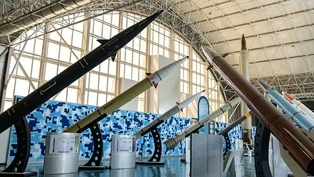
>> (speaking Farsi): ♪ ♪ >> WALKER: Our minders take us to the Islamic Revolutionary Guard Corps missile museum, where Iran's latest military hardware is on display.
It's believed some of these ballistic missiles could be capable of carrying nuclear warheads.
♪ ♪ Despite the 12-Day War, Iran and its leaders continue to shroud its nuclear program in secrecy and mystery.
It's time to leave Iran and seek answers elsewhere.
We travel to Vienna, home to the IAEA, the world's governing nuclear watchdog.
Rafael Grossi is the head of the agency.
His inspectors were on the ground in Iran prior to the bombing, but haven't been allowed to return to the sites hit by the U.S.
and Israel.
You have the ability to assess damage in a unique way that others don't.
What, what was your initial assessment after the strikes on the, on the key facilities, Natanz, Fordow, and Isfahan?
>> Obviously, without having physical access to a place, any evaluation is partial, is not complete.
But the difference between our assessment and the assessment of anybody else is that we knew exactly what was inside.
>> WALKER: Can you give us an overall picture of what that determination was?
>> The determination was and still is that the damage was very substantial.
Very substantial.
>> WALKER: While President Trump has insisted that Iran was nearing a bomb, Grossi says he hasn't seen evidence of an active weapons program.
But he's concerned about the amount of enriched uranium Iran was stockpiling.
How far do you think Iran is today from developing a nuclear weapon?
>> I think here we have to be very careful what we say.
All the access and inspections that we were carrying out allowed us to determine that there, there's no credible information that would lead us to believe that they were developing a nuclear weapon.
So this, I think, has to be said very clearly.
As well as the rest.
A number of, I mean, a huge amount of near-weapon-grade enrichment, and, of course, these technological capabilities that were there, which were a source of legitimate concern by the international community.
>> WALKER: Do you think that there is a risk from these strikes that it pushes Iran's nuclear program further underground?
>> If time passes and, and inspections do not resume, well, then there will be doubts.
And I mean, I'm not saying that there will be an immediate consequence, but certainly, the situation will, will become a source of a greater concern, in terms of nonproliferation or the potential activities leading to a nuclear weapon.
♪ ♪ >> WALKER: At the Imamzadeh Saleh mosque in Tehran, nuclear scientists and military commanders killed in June are buried and venerated as heroes.
The country is at a crossroads over its nuclear future and how its adversaries will respond.
So how are people feeling now?
Are you expecting or worried about more conflict that's coming?
>> Yeah, of course, because they say it's not ending.
And every day it's passing that Trump say one thing, Netanyahu say another.
And every night that we want to go to asleep, we don't know if that tomorrow, we wake up or not.
>> We must not allow Iran to rebuild its military nuclear capacities.
Iran's stockpiles of enriched uranium, these stockpiles must be eliminated.
>> My position is very simple.
The world's number one sponsor of terror can never be allowed to possess the most dangerous weapon.
>> WALKER: What's your message to the Trump administration if there are more attacks?
What will be the consequences that?
>> (speaking Farsi): ♪ ♪ >> NARRATOR: Go to pbs.org/frontline for more of our interview with Iran's chief nuclear negotiator.
>> How much has this set back Iran's nuclear program?
>> (speaking Farsi): >> NARRATOR: Find additional reporting with our partners at The Washington Post.
And see our past films and coverage of Iran.
Connect with FRONTLINE on Facebook and Instagram and stream anytime on the PBS app, YouTube, or pbs.org/frontline.
Captioned by Media Access Group at WGBH access.wgbh.org >> For more on this and other "FRONTLINE" programs, visit our website at pbs.org/frontline.
♪ ♪ FRONTLINE's "Strike on Iran: The Nuclear Question" is available on Amazon Prime Video.
♪ ♪
"Strike on Iran: The Nuclear Question" - Preview
Video has Closed Captions
Preview: S2025 Ep17 | 31s | An investigation of Iran’s nuclear program in the aftermath of the U.S. and Israeli strikes. (31s)
Providing Support for PBS.org
Learn Moreabout PBS online sponsorship
- News and Public Affairs

Top journalists deliver compelling original analysis of the hour's headlines.

- News and Public Affairs

Amanpour and Company features conversations with leaders and decision makers.












Support for PBS provided by:
Funding for FRONTLINE is provided through the support of PBS viewers and by the Corporation for Public Broadcasting. Major funding for FRONTLINE is provided by the Ford Foundation. Additional funding...