
Montana Gluten Free Oats
Clip: 4/13/2026 | 4m 48sVideo has Closed Captions
Montana farmers cash in on a growing demand for gluten free farm crops.
Montana farmers cash in on a growing demand for gluten free farm crops.
Problems playing video? | Closed Captioning Feedback
Problems playing video? | Closed Captioning Feedback
America's Heartland is presented by your local public television station.
Funding for America’s Heartland is provided by US Soy, Sustainable Agriculture Research and Education, Rural Development Partners, and a Specialty Crop Grant from the California Department of Food and Agriculture.
Montana Gluten Free Oats
Clip: 4/13/2026 | 4m 48sVideo has Closed Captions
Montana farmers cash in on a growing demand for gluten free farm crops.
Problems playing video? | Closed Captioning Feedback
How to Watch America's Heartland
America's Heartland is available to stream on pbs.org and the free PBS App, available on iPhone, Apple TV, Android TV, Android smartphones, Amazon Fire TV, Amazon Fire Tablet, Roku, Samsung Smart TV, and Vizio.
Providing Support for PBS.org
Learn Moreabout PBS online sponsorship>> A balanced diet means more than just fruits and vegetables.
And while grains like wheat, barley and rye deliver important proteins and healthy fats, they also contain gluten.
Gluten is a protein that can adversely affect some with gluten sensitivity.
Which is why.... oats are high on the list of those trying to avoid gluten.
Our Kristen Simoes says that's provided some new opportunities for farmers in Montana.
♪♪ >> It's harvest time for Bruce Wright on his family farm in Bozeman, Montana.
>> We grow some wheat and barley and hay and peas and some sunflowers.
And then a specialty oat that we're working on.
>> That "specialty" oat now covers acres of land here.
And for a farm with roots dating back to the 1800s, that oat is changing the future for this farmer and for thousands of people who suffer from gluten sensitivity.
>> The oats are special because they are a variety that was developed by Montana State University.
And what we've found in these oats is that they are a hull-less variety of oat and they're very low in allergens.
And oats in general don't have any gluten in them so we can take these oats and process these oats and make them into oatmeal and porridge and flour and stuff that can be eaten by people who have gluten sensitivities.
>> "Gluten" is a natural protein composite found in grains like wheat, barley and rye.
It gives texture and elasticity to dough.
It's also used as a flavor enhancer and thickener which means you'll find it in everything from soups to salad dressings.
"Gluten free" labeling on products at the supermarket is important for those suffering from Celiac Disease which is associated with intolerance to gluten in grains.
>> The demand is growing because the awareness of celiac disease and gluten intolerance is growing.
now the doctors are becoming more aware of celiac disease, gluten intolerance, so it's becoming more diagnosed and more people are paying attention.
>> Producing this product is high-tech, high cost and high science.
The combines used to harvest these oats won't be used for other crops- for fear of cross contamination.
The oats are hauled to a processing plant to pass through a series of cleanings and crushings.
>> From there it goes into the second cleaner, does more of the same thing, cleans it out.
Goes from that second screening machine into a series of stacked indent cleaners.. Then it goes up into the roller mill.
That's what takes and rolls the oat into a flake and what we usually call oatmeal.
>> Their focus is to provide specialized crops for gluten free products to meet an increasing demand from consumers.
>> These are your short oats these are the ones we want and you haven't seen these before in the field.
>> Dr.
David Sands has been working with Bruce on food production for the past eight years.
>> How important are farmers in, in getting new products like this to the market?
Dr.
David Sands: Well if they don't grow it, it won't happen.
So you have to produce a crop that they want to grow, that makes a difference in, in their income, and also they are growing food crops.
They are as interested in the human consumer as anybody else.
>> What they're interested in is the different varities... >> Laboratory work at Montana State University centers on testing oat varieties... >> The overall goal is to make a more perfect food.
A food that is designed around our genomes and our genomes are different so you're going to have these different groups of people wanting different things.
And why shouldn't they, and why shouldn't we produce exactly what they want.
>> And for those consumers "wanting" gluten free blueberry pancakes, Bruce and others can stop by Bozeman's Main Street Over Easy Restaurant.
>> It is really gratifying.
When you talk to somebody who hasn't been able to eat, uh, bread or something like that, they, they're so happy to be able to have that again, they really, really appreciate their food.
>> I love what I do.
I love being able to grow things, I love to be out here in the countryside, uh, and the beautiful scenery, one of the most beautiful spots.
I, I'm so lucky to get to work here.
 New
NewVideo has Closed Captions
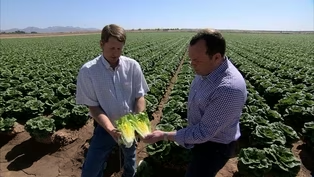
Farmers harvest lots and lots of lettuce from America's winter salad bowl in Arizona. (4m 44s)
 New
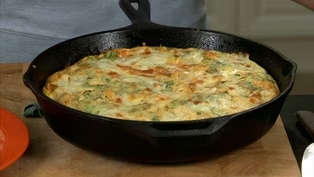
NewFarm to Fork Cauliflower Frittata
Video has Closed Captions
On Farm to Fork, we’ll learn how to prepare a frittata made with cauliflower. (6m 36s)
 New
NewVideo has Closed Captions
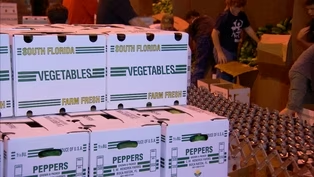
Growers down south step up efforts to help the hungry as part of “Farmers Feed Florida.” (6m 24s)
Providing Support for PBS.org
Learn Moreabout PBS online sponsorship
- Food
Christopher Kimball’s Milk Street Television
Transform home cooking with the editors of Christopher Kimball’s Milk Street Magazine.








Support for PBS provided by:
America's Heartland is presented by your local public television station.
Funding for America’s Heartland is provided by US Soy, Sustainable Agriculture Research and Education, Rural Development Partners, and a Specialty Crop Grant from the California Department of Food and Agriculture.