Here and Now
Dane County Returns 165 Acres to the Ho-Chunk Nation
Clip: Season 2400 Episode 2449 | 5m 55sVideo has Closed Captions
The Ho-Chunk Nation will receive 165 acres in a land transfer funded by Dane County.
The Ho-Chunk Nation will receive 165 acres of their ancestral homelands in a land transfer funded by the Dane County Conservation Fund in collaboration with the Dane County Land and Water Resources Department.
Problems playing video? | Closed Captioning Feedback
Problems playing video? | Closed Captioning Feedback
Here and Now is a local public television program presented by PBS Wisconsin
Here and Now
Dane County Returns 165 Acres to the Ho-Chunk Nation
Clip: Season 2400 Episode 2449 | 5m 55sVideo has Closed Captions
The Ho-Chunk Nation will receive 165 acres of their ancestral homelands in a land transfer funded by the Dane County Conservation Fund in collaboration with the Dane County Land and Water Resources Department.
Problems playing video? | Closed Captioning Feedback
Where to Watch Here and Now
Here and Now is available to stream on pbs.org and the PBS app.
Providing Support for PBS.org
Learn Moreabout PBS online sponsorshipbehind.
>> Republican Andy Manske is also running.
In other news, the Ho-Chunk nation will receive 165 acres of their ancestral homelands in a land transfer.
The effort was funded by the Dane County Conservation Fund in collaboration with the county's Land and Water Department.
Here and now, reporter Erika Ayisi went to the site to hear how the Ho-Chunk will use the property.
This report is in collaboration with Icty, formerly Indian Country, today.
>> Every plant is a resource, right?
They say everything our Mother Earth gives us.
He goes like, that is a form of medicine.
You just have to find out what it is so you can smell that.
historic preservation officer for the Ho-Chunk nation, says plants can soothe sores on the body.
>> It allows you to heal a little bit better.
So it's a different form of medicine.
mounds, and waterways in the Lower Mud Lake Natural Resource Area are a part of 165 acres of property returned to Ho-Chunk nation from Dane County.
Quackenbush says the land acquisition is an opportunity for the public to learn.
>> So the milkweed itself, we call it Marquette.
You just during this time of year, these heads over here, while they're really young, you pick that and it doesn't hurt the plant at all.
Once you gain the knowledge and use of it there, that's something that we tend to pass on from generation to generation.
The plants.
>> So nearly $6.5 million from the Dane County Conservation Fund was used to purchase a private property south of Babcock County Park, including significant frontage along Yahara River Lower Mud Lake and Lake Waubesa.
Dane County will place it in a conservation easement in partnership with Groundswell Conservancy, a nonprofit environmental organization, to permanently prohibit development, preserve public access and protect the land's cultural significance.
>> Ho-Chunk nation will own and manage the land, steward the land in perpetuity.
>> Quackenbush says.
The Ho-Chunk are the land's original caretakers.
>> We're the only tribe that has the ability to speak confidently about the.
We were the first and original people from this region right here.
>> When you say ancestral territories, we're Ho-Chunk always here.
>> We have beautiful stories that talks about how we adapted through time from living in a place of refuge and moving back into these first places as that glacier began to recede.
>> He says.
Their oral history talks about their cultural and environmental adaptation.
As Ho-Chunk people moved through the region for thousands of years.
>> That place of refuge that we referred to, today's society calls Driftless Area.
>> He says.
Their indigenous language mentions red banks of the past that are still evident in Wisconsin today.
>> We say Moogasuc in our language.
It places you exactly where that location is.
These red banks that are associated with this ancestral place of origin.
>> According to Quackenbush, the Ho-Chunk nation will be solely responsible for costs including property taxes and maintenance of the land.
With insight from the conservancy that includes six archeological sites and 22 ancient burial mounds.
>> There's a mound system that rises right straight through it that's nothing more than a large mortuary site.
It's like walking across a burial system.
For modern people out there, there's some respect that needs to be instilled in that.
>> According to archeologists, there's at recorded archeological sites in the Dunn Township part of Dane County.
But the sites on the 165 acres donated to Ho-Chunk were lost in a series of treaties between the Ho-Chunk and the federal government during the 1800s, long before Wisconsin was an established state.
This began an era of forced removals for Ho-Chunk, the original caretakers of this land and its waters.
>> By captions in time in the 1800s, primarily where a lot of land was ceded because there was forced removals.
>> Jon Greendeer, president of the Ho-Chunk nation, says the treaties forced the tribe to relocate across the Midwest, but they returned to Wisconsin.
>> We were able to not only survive in some of those regions, we were also able to thrive and repopulate.
>> Ho-Chunk became an official nation in 1963, and today has about 8000 enrolled members.
Greendeer says the land acquisition is about regaining their cultural footprint on their ancestral homelands.
>> For the Ho-Chunk nation, we never really believed in land ownership.
We believed that the land was there for us to use as we need it.
>> Considering that there's a conservation easement between Dane County and Groundswell Conservancy, who is on the title in this project.
>> The Ho-Chunk nation is going to be entitled to the project, and it's going to be a part of anything going forward.
If there's any decisions to be made in terms of development in that area.
>> As to the property, Groundswell Conservancy says the group, along with Dane County, will do annual visits to the location.
>> To make sure that the conservation values are being upheld in conjunction with the Ho-Chunk nation.
>> And support Quackenbush in meeting the tribe's goals to preserve the site.
>> What we want is the protection and enhancement of the environmental resources.
for the public to sit and engage and learn.
>> This property is a beautiful educational opportunity unfolding before our eyes.
>> In Madison.
I'm Eric >> In Madison.
I'm Eric
 New
NewCandidates for Governor Make Their Case to The Parties
Video has Closed Captions
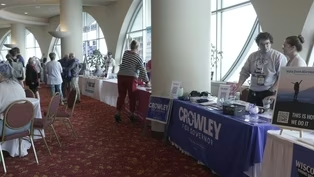
Clip: S2400 Ep2449 | 5m 45s | Candidates running for governor made their appeals at the annual party conventions. (5m 45s)
 New
NewHere & Now opening for June 19, 2026
Video has Closed Captions
Clip: S2400 Ep2449 | 1m 8s | The introduction to the June 19, 2026 episode of Here & Now. (1m 8s)
 New
NewIranians in Wisconsin React to US-Iran Peace Negotiations
Video has Closed Captions
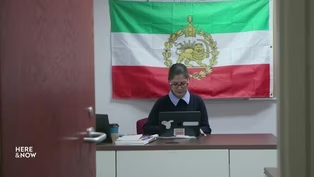
Clip: S2400 Ep2449 | 5m 56s | Iranians in Wisconsin discuss the Iranian government in light of announced peace talks. (5m 56s)
 New
NewJason Stein on Budget Headwinds Facing Milwaukee
Video has Closed Captions
Clip: S2400 Ep2449 | 5m 18s | Jason Stein on a $50 million dollar deficit in one year in the Milwaukee County budget. (5m 18s)
 New
NewWisconsin Senators on The Memorandum of Understanding
Video has Closed Captions
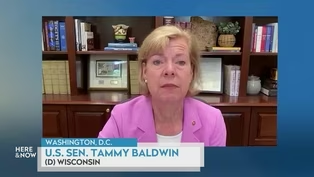
Clip: S2400 Ep2449 | 1m 33s | Tammy Baldwin and Ron Johnson on the announced peace talks to end the Iran war. (1m 33s)
Providing Support for PBS.org
Learn Moreabout PBS online sponsorship New Episode
- News and Public Affairs

Top journalists deliver compelling original analysis of the hour's headlines.
 New Episode
- News and Public Affairs

Today's top journalists discuss Washington's current political events and public affairs.
 New Episode
 New Episode
 New Episode
 New Episode


 New Episode
 New Episode
 New Episode
Support for PBS provided by:
Here and Now is a local public television program presented by PBS Wisconsin