
Yellowstone: Is It a Volcano?
Clip: Special | 1m 4sVideo has Closed Captions
What is a super eruption and how did they create the geology of Yellowstone?
Where is the world's largest, most explosive, and most unusual volcano? It's Yellowstone National Park. The Yellowstone area has had a history of super eruptions and a large caldera. Learn more about the geologic history of this amazing volcano.
Problems playing video? | Closed Captioning Feedback
Problems playing video? | Closed Captioning Feedback
Science Trek is a local public television program presented by IdahoPTV
Major Funding by the Laura Moore Cunningham Foundation and the Idaho National Laboratory. Additional Funding by the Friends of Idaho Public Television and the Corporation for Public Broadcasting.
Yellowstone: Is It a Volcano?
Clip: Special | 1m 4sVideo has Closed Captions
Where is the world's largest, most explosive, and most unusual volcano? It's Yellowstone National Park. The Yellowstone area has had a history of super eruptions and a large caldera. Learn more about the geologic history of this amazing volcano.
Problems playing video? | Closed Captioning Feedback
How to Watch Science Trek
Science Trek is available to stream on pbs.org and the free PBS App, available on iPhone, Apple TV, Android TV, Android smartphones, Amazon Fire TV, Amazon Fire Tablet, Roku, Samsung Smart TV, and Vizio.
Science Trek
Science Trek is a place where parents, kids, and educators can watch short, educational videos on a variety of science topics. Every Monday Science Trek releases a new video that introduces children to math, science, technology, engineering, and math (STEM) career potentials in a fun, informative way.[MUSIC] JOAN CARTAN-HANSEN, HOST: Where is the world's largest, most explosive and most unusual volcano?
It's Yellowstone National Park.
Now, Yellowstone doesn't exactly look like your typical volcano.
Scientists define a volcano as an area that sits atop a giant active magma chamber, which is caused by hot rock rising from the earth's lower mantle, which causes hydrothermal activity, and has a history of eruptions.
That's Yellowstone.
And it's not just a volcano.
Yellowstone is also a caldera caused by a super eruption.
A super eruption is one that releases more than 240 cubic miles of material.
That's equal to the volume of two Lake Eries.
A caldera happens when a volcano eruption is so large that the surface collapses in on itself, leaving a huge crater.
The Yellowstone caldera is 45 miles long by 30 miles wide.
The river in the Grand Canyon of the Yellowstone slices through the sediments and lava flows of the Yellowstone caldera.
For more information about Yellowstone, check out the Science Trek website.
You'll find it at sciencetrek.org
Yellowstone: Bizarre Yellowstone
Video has Closed Captions
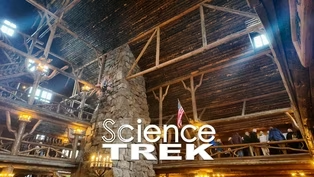
Clip: Special | 1m 4s | Yellowstone has some bizarre locations you might not know about. (1m 4s)
Providing Support for PBS.org
Learn Moreabout PBS online sponsorship
- Science and Nature

Explore scientific discoveries on television's most acclaimed science documentary series.

- Science and Nature

Capturing the splendor of the natural world, from the African plains to the Antarctic ice.











Support for PBS provided by:
Science Trek is a local public television program presented by IdahoPTV
Major Funding by the Laura Moore Cunningham Foundation and the Idaho National Laboratory. Additional Funding by the Friends of Idaho Public Television and the Corporation for Public Broadcasting.