
The River Carries the Stories - Aboard the Riverboat City of New Orleans
7/18/2026 | 26m 46sVideo has Closed Captions
Dook's dishes: Venison with Turnips and Onions, Mushroom and Wild Rice Pilaf, and Squash and Shrimp.
On this episode of Dook Chase: A Chef's Journey, the chef boards the Riverboat City of New Orleans to explore the Mississippi River's influence on the city with Matt Dow of the New Orleans Steamboat Company and a family of riverboat captains. Inspired by his river journey, Dook heads to the kitchen to prepare Venison with Turnips and Onions, Mushroom and Wild Rice Pilaf, and Squash and Shrimp.
Problems playing video? | Closed Captioning Feedback
Problems playing video? | Closed Captioning Feedback
Dook Chase: A Chef's Journey is presented by your local public television station.
The River Carries the Stories - Aboard the Riverboat City of New Orleans
7/18/2026 | 26m 46sVideo has Closed Captions
On this episode of Dook Chase: A Chef's Journey, the chef boards the Riverboat City of New Orleans to explore the Mississippi River's influence on the city with Matt Dow of the New Orleans Steamboat Company and a family of riverboat captains. Inspired by his river journey, Dook heads to the kitchen to prepare Venison with Turnips and Onions, Mushroom and Wild Rice Pilaf, and Squash and Shrimp.
Problems playing video? | Closed Captioning Feedback
Where to Watch Dook Chase: A Chef's Journey
Dook Chase: A Chef's Journey is available to stream on pbs.org and the PBS app.
Providing Support for PBS.org
Learn Moreabout PBS online sponsorshipNARRATOR: Major funding for Dook Chase: A Chef's Journey was provided by the Melvin S. Cohen Foundation Incorporated.
Additional support by Zatarain's, bringing the flavors of New Orleans home for over 125 years.
Zatarain's, born and raised in New Orleans.
From the spice of jambalaya to the flavors of a classic crab boil, it's a taste of New Orleans made at home.
And by Camellia Beans, rooted in New Orleans since 1923, a family business with a devotion to beans spanning four generations.
Camellia Beans, a taste of home.
DOOK: Hi, I'm Dook Chase.
On the first chapter of "A Chef's Journey," we're exploring the mighty Mississippi on the riverboat, the City of New Orleans.
We'll talk to Matt Dow of the New Orleans Steamboat Company about the magic of the river, and meet three members in a family of riverboat captains.
The waters of the river have always carried the stories and traditions of the people of this region.
So let's go on board and experience the majesty of our river heritage.
♪ (theme music playing) ♪ DOOK: We're on the riverboat, the City of New Orleans, the running mate to the Steamboat Natchez, and I'm here with Matt Dow, Director of Maritime Operations.
MATT: Yes, indeed, good morning, Chef.
DOOK: Thanks for having me.
MATT: Thanks for coming on board.
DOOK: Yeah, so I hear you grew up not only uh, like we did in a restaurant, making sure everything was right on these boats, on these vessels.
Tell me a little bit about your story.
MATT: I grew up on these boats, and I just love them and I just, I just knew this is what I wanted to do.
From an early age, I had brown water in, in the blood.
DOOK: So your father actually came down and, and started the Steamboat Natchez.
How did that come about?
MATT: We have another steamboat company, it was actually the parent company to New Orleans Steamboat.
It's up in Lake George, New York.
It's a little town in the Adirondack Mountains.
Now, that company was actually started in 1817.
So my grandfather purchased the company after the Second World War in 1945, then my dad got involved up there, and ended up over here in New Orleans on Easter Sunday of 1972.
He parked his car, he walked through the French Quarter, walked up on the levee by Jax Brewery, which was still running at that point in time, and came upon the Mississippi River here at the Toulouse Street Wharf, which, at that point, was dilapidated.
You know, he kind of looked around, and he said, "You know, I think this would be a great place for a boat."
You know, he just felt the magic of this city from the get-go and just knew that was it.
That was the place.
That was where we were going to start the New Orleans Steamboat Company, and that's what happened.
DOOK: Yeah.
MATT: On a whim.
DOOK: I think you feel that, right?
The magic, the energy of that river.
MATT: It may look calm, but you've got all these currents and countercurrents.
It's feisty, and you've got to be the best of the best to be able to operate a boat out here, and especially right here in the bend of the river, where things can get really squirrely sometimes.
DOOK: In talking about the best of the best, I know there's some story of, of also some generational lines with the boat captains of you all's fleet.
MATT: From the get-go, my grandfather, Wilbur, and my father, Bill, wanted a family-owned and family-operated operation.
You know, family is at the core of everything that we do, and what I strive to do as a third generation now, uh, we're so lucky that we've got a lot of families that work here.
DOOK: Standing here, I can feel the strength of this river, its identity of influencing the city, culture, heritage, traditions.
So much is shared up and down this river.
Tell me, just how does it feel for you to operate and feel that as people come on?
MATT: It's immensely important.
Without the river, the city wouldn't be here.
It wouldn't be what it is.
From the get-go, this river was important.
I mean, not only for commerce, you know, trading, but the culture of this city is based around this.
I mean, look at the music, right?
Jazz.
And I think that's a big part of you know, what we still do here on the steamboats is, is keep that jazz tradition going.
♪ ♪ This is where we came from, this river, so you have to remember that to know where you're going.
So it's nice to be able to carry that tradition on this beautiful river.
DOOK: Well, we certainly want to meet the generational aspect of the captains here, because I can't wait to get this thing rolling.
♪ So I'm sitting here with two generations, Captain Steve and Captain Steven.
Captain Steve, talking about not only navigating this mighty Mississippi River, but also doing that and having multiple generations come behind you, how, how, how does that feel?
STEVE: It's a wonderful feeling for me, you know.
The company I work for is a family company, so it's only appropriate that my kids follow my footsteps.
DOOK: So, Captain Steve, you actually were here on the Steamboat Natchez since the beginning.
STEVE: Yeah, I, I was born and raised in Louisville, Kentucky, and I worked on a steamboat up there called the Belle of Louisville, and the captain was hired by Mr.
Wilbur Dow to come bring out the brand-new Steamboat Natchez in 1975.
I got a letter in the mail one day from Captain Hawley, and invited me to come down and be part of the new crew.
The Natchez is very special, so for the next several decades, I was a deckhand, I was a watchman, I was a mate, pilot, and then eventually became the captain.
But uh, it's a special boat and a special city.
Well, Steven ended up not only later on became the master of the Natchez, but he worked in the engine room, in the boiler room.
He did some food running for the, for the galley, and so he experienced multiple levels of this, of this boat life.
STEVEN: Growing up on the boat, it was, it was, it was a very unique experience, you know.
Not too many people can say, "Hey, I'm going to work with my dad on a steamboat."
Realizing as I got older how important it was, kind of working with your dad and, and especially taking in all the knowledge he's learned over the years, and it's, it's very special, and I'm, you know, taking you know, what I learned from him and passing on to the next generation.
STEVE: What he and I do, to the layman, they go in the pilothouse, and they see what appears to be the easiest job in the entire world.
You're just sitting there, and it's not a high-impact, very physical job that you're real busy at.
It's all up here.
When you're coming up to receive your pilot license, you have to draw the river on a blank piece of paper, one mile at a time.
For example, if you end up licensed from New Orleans to Baton Rouge, you have 135 miles of river to draw from memory.
You got to tell what's on the shores, what's going under it, where the navigation lights are, what color they blink, how often they blink.
It's pretty entailed.
A pilot has to be quite knowledgeable.
DOOK: Well, we certainly appreciate you all navigating us.
I do understand there is another generation, a family member that's keeping this legacy going, so we should be safe in New Orleans for quite some time... STEVE: Well, I sure hope so.
DOOK: ...going up and down this river.
STEVE: Yeah, because as I go out the door, grandson's coming in.
So we're here with Captain Skyler, third generation of the vessel, the City of New Orleans.
Tell me a little bit about this ship.
SKYLER: So we got this vessel back in 2016 from Seattle.
She was previously the casino vessel.
DOOK: Okay.
SKYLER: So we had to gut her out.
She was in, we call a layup, in about 2017 to 2019, and we've been running here from Lower Bienville Street Wharf ever since.
DOOK: So now coming up, just tell me, how does it feel to be a captain on the river?
SKYLER: Um, it's definitely challenging.
Coming in here, being a captain now, it gives you a perspective of how it was then, and looking at the generation before me, and finally being in their footsteps is the unique experience, one I don't take for granted.
DOOK: We use the term continuing the legacy and really coming behind those generations.
It's, it's really the job just to make them proud and hopefully keep growing.
SKYLER: Yep, that's the, that's the plan.
I have a daughter that turns six this year, so she's always wanting to come on the boat, so she might be a female captain later down the line.
DOOK: Well, I love it, and I'm looking forward to seeing you navigate this vessel and just tell the story of this river and really define New Orleans.
This journey starts on the Mississippi River, the heart of our cultural identity.
As you think back to those times where this was the only mode of transportation up and down, you're on a beautiful ship, you're having great food, you have a great ambiance, you're hearing great music.
You know it's, it's fitting that we get this picture on the river with the bridge behind us, because it speaks to connectivity.
You understand the mixture of Creole cuisine and Cajun cuisine.
You understand how we all tapping into the same food pantry.
You understand those different influences that we had on our cuisines from so many different cultures because we learn from each other.
We all had to travel the same waterway, and that's where it all comes from.
You know, people coming together, sharing stories, sharing their family heritage, sharing their family traditions, and we all learn from that.
This river journey certainly has inspired me to get back in the kitchen.
When you think of its power, its connectivity, its influence on our cuisine, its influence on our music, it has certainly shaped the identity of New Orleans.
Welcome to my kitchen, where inspiration and creation come together in a celebration of culture.
Today, we're talking about the river, and when you think about the history of the river, we're talking venison, we're talking turnips with a citrus watercress salad.
So here, we have some turnips that are already prep-peeled and diced into an inch cube.
I'll show you how we do that.
What you're really looking to do is you just want to get a paring knife, and you want to come through this turnip just like here, and for me, I just kind of roll it around.
But the reason why we soak it in that water is because that oxygen, it'll start to turn that turnip brown, and you want to keep that color as white as or as light as possible.
So we're going to start with a little butter here, and then we'll start add our onions.
When you're thinking about layering flavor, right?
That's the part where you want to just add at each step, I always like to add a little salt, a little pepper.
We're going to bring in our turnips, right?
I have them soaking in this water, but you do not want to bring that water to this pot.
You're going to start to add them right on top.
So here, we have our turnips in a pot, and as you add, you add flavor, you add seasoning.
So we're going to come back to it with a little salt here, with a little pepper, and certainly a herb that we always cook with, a little dried thyme.
And at this point is where I'll start to add my garlic.
So we'll just fold that in here.
And what I'm looking for here is just to get a nice little sizzle before I add this stock to it.
So here we are, we're right at that point where we'll add just a little chicken stock, and as you can see, I'm not going to cover it too much, and that's right where we are.
We're creating that bed.
So this is the point where I want it to be.
It's going to develop.
We're going to let that go.
So now we're talking about the star of the show, and that's this beautiful venison here.
This is what we call a backstrap, or the venison tenderloin.
So here, I have just a little salt.
We have a little pepper here, and we have a little granulated garlic just to give it a little hint.
One thing you want to do is you want to season both sides of this meat.
So just a little bit of regular vegetable oil, and now I'm going to add just a little bit of butter here.
And that's what we're looking for.
You want to get a great sear on it, and we're going to start to add that beautiful tenderloin.
And how I prefer to cook this meat is, I'm looking for a medium rare.
It's probably about two and a half minutes.
And you can start to see, as you're looking in this pot, that meat, that coloration, is going to come out just a little.
You can start to smell that seasoning.
You want to flip.
And if you can see that beautiful color on there, that's what we're looking for.
You want this to cook quick because you want to sear it in, and you want to make sure you lose none of its juices here.
And that's what we're doing here.
We're allowing that meat to sear on all sides of this beautiful venison.
Now we're going straight into the oven.
My oven's preheated at 400.
For a good medium, medium rare, you just want this to go in the oven for five to seven minutes.
So we have some beautiful watercress here.
You just want to enhance it.
You want to brighten it up.
We have a little olive oil here, and what we're doing is just a, a light vinaigrette.
This is a little dash or two of vinegar here.
I'll add just a pinch of salt, a pinch of pepper.
I'm going to fold these greens right at the last minute.
So now we're going to go ahead on and pull that venison out the oven.
So when you come out the oven, you have to let this venison rest a little bit.
So we're going to put it right here on a cool spot.
We see our beautiful turnips are here.
They're ready.
So all you're looking to do is just give this a little shine.
I have a bunch of greens here.
And the last thing we'll finish that off with is just the orange zest that will go here, but this gives it that freshness.
So now we're at the finishing stage of our dish.
That tenderloin is resting.
You just look at it.
It's just beautiful.
And we come in right here and just show you what we're looking for.
And as it flows, you're going to see... you see that beautiful ring that we have around here?
That's what you're looking for.
You're looking for a medium rare.
We're going to come here, and I'm just adding a little butter, just in this pot.
Stir it around just to finish that sauce, right?
You never want to lose flavor.
You don't want that butter to sizzle.
You just want it to have a finishing glaze on that sauce that we'll do.
So now it's time to plate.
And you just start to create a bed for it.
And you, you take this beautiful venison that we have, and we're just going to rotate it right there.
Now we're going to finish just with a beautiful watercress salad, lightly vinaigrette, a little citrus.
This is speaking Louisiana.
And you thought I forgot about that beautiful sauce, huh?
I did not.
And all you want to do is just a light drizzle.
This venison, this turnip, this citrus watercress, so simple, so easy to do at home, but it speaks volumes of culture and celebration.
Wild rice and mushroom pilaf.
I mean, when you talk about a perfect side dish that pairs well with many proteins, especially that venison we just finished.
But let's go ahead on and get started.
We add a little bit of butter.
I have my pot on a medium to low heat.
Stir that around here.
I have some onions, and again, you know the process.
As we go, we're talking about layering, right?
We're not just adding everything at one time.
You get those onions start to working, start to get in that flavor, that butter speaking to those onions.
But look at these beautiful mushrooms that we have here, this oyster mushroom.
We also have some baby bella mushrooms.
And that's where I want it to be.
I'll start to add some of these bell peppers.
Not only are they going to add some flavor and some sweetness to this dish, but they're going to add that beautiful color that you see here.
And while you're talking of that color, you don't want to cook them down too much because you want it to still have that texture.
You want it to still have that brightness of that color.
So now as we added that, I'll certainly start to add a little dry thyme.
I'll add a little salt, and then we have a little cayenne pepper.
So now we'll bring this rice, and we'll put it right in here.
We use a little bit of wild and long-grain rice.
We mix it up.
It's a two-to-one ratio.
You know, nothing better than at the bottom of this pot, that rice that's at the bottom, that popcorn or whatever you call it, it has the flavor and that crunch.
That's what you're looking for.
So if you can see, I didn't add those mushrooms yet, right?
I want this to shine.
This is the point where we'll add the garlic to this dish.
So we'll add a little bit of garlic here.
Give that a little turn.
And now we bring in these beautiful mushrooms.
You want to make sure you have enough mushrooms that everybody gets a, a bite of some greatness.
Now, here we'll add just a little bit of chicken stock.
And as you know, cooking rice is a two-to-one ratio.
If you don't want to use chicken stock, you can certainly use water here.
As you use water, just make sure you adjust for that salt content.
You might have to add a little more.
So what you're looking for is you want to bring this pot to a nice simmer, but before you put that cover on, you have to taste it.
I'll give this a little taste.
Oh, that's good.
Just a tad bit of salt.
So this is what you're looking for, you can see those bubbles, that boil's starting to come right around.
You add this cover, and you turn this down to a low heat, even a simmer.
You want to let this simmer for 20 minutes.
As that develops, that flavor, that rice starts to bloom and get fluffy.
This is going to be delicious.
So it's been simmering for 20 minutes, and now we'll open it up.
Oh, my.
You can just get hit with that beautiful smell.
And this is the part where you just want to start to fluff up that rice.
And what you see at the bottom, I love that sizzle, because I know that popcorn rice that I love is coating at the bottom of this pot.
And this is just beautiful.
This is ready to plate.
And we'll move it over and have a beautiful dish here, and just look at that.
Oh, that mushroom, that pepper coming through, the texture that you're going to get on that wild rice.
Now we're getting to my favorite part.
This is the chef's rice, that rice that's stuck to the bottom, that has that texture, just that crispiness, full of flavor.
I'm going to put this on the side for me.
We'll add a pinch of color right here.
This dish is the perfect side to any protein that you have.
People will smell this coming from that kitchen when you dive in.
It just adds perfection to anything you're making.
As we travel down the river, we find ourselves to the Gulf, and that beautiful bounty of seafood, whether you're talking blue crab, whether you're talking red fish, whether you're talking anything you can imagine, but Gulf shrimp is always perfect.
So this dish, beautiful summer squash, Gulf shrimp, easy, quick to cook.
We'll start off with a little butter going right in here in this pot.
We don't want to brown our butter.
We'll just start to layer in, right?
We'll start adding some onions.
Really, what you're looking for anytime you add that onion, you're looking for a translucent, right?
We're not looking to brown them.
We're just looking for them to start to get clear, start to get translucent for us.
This is right where we want it to be.
I'll add in just a little bit of salt to have it speak.
And now we'll start to add in our beautiful squash.
You take the stems off, you slice them in half, because they have to cook in the same time as your shrimp is going to cook.
So when you're looking about preparing dishes that have protein, you have to have that shape and size that's going to cook at the same amount of time.
So we'll add in some of this squash here.
The beautiful thing I love about summertime with these beautiful squash, and when you're looking at just the sweetness of that shrimp, you're telling the story of, of the garden that's coming up with the squash, but you're also telling that story of that river touching the Gulf.
So you're picking up that beautiful seafood.
Once you add the squash, of course, we're going to add that beautiful dried thyme here.
We have to hit it with a little more salt.
And I do just a tad bit of cayenne pepper.
And then this is the time where I can add in the garlic.
Now, here, you don't want that, that bottom of that pot to become dry.
So if you see it's getting dry, you add just a tad bit more butter right on that side, and then you let it work.
Because you also want to create a bed, so when you add that shrimp, it has something to start working with as well.
We'll let these squash go for just about three or five minutes.
And this is where you want it to be.
You can see that onion, that all is coated.
The garlic's coated.
That dried thyme, that cayenne pepper, the salt.
Here's the perfect time that we start to add our shrimp.
So what I'm using here is a 21/25 peeled and deveined shrimp.
The count is the size of the shrimp.
It's how many you get per pound.
21/25, you're getting 21 to 25 shrimp per pound.
The smaller the number, the bigger the shrimp.
And when you add that shrimp, of course, we got to add a little more seasoning here.
I'll hit it with just a little more cayenne pepper.
And this won't take any time.
So when you think about it drying up, that shrimp, as it cooks, is going to release those juices.
I want those juices to coat into that summer squash.
I want that flavor just to come together and marry together.
And you don't want to overcook shrimp.
That's why we started that squash first, because we knew the shrimp is only going to take us about five minutes.
So I want that squash just to be tender enough, right when it's time, and that shrimp is perfectly cooked.
So, how you know when shrimp are done?
One, it can start to curl, but you're looking for that color, right?
They'll start to go from pink, then they'll start to have that white.
So you don't want to overcook it.
You don't want to get it to too mushy.
You want to stop it right when it's at that perfect time.
You know, you can see this one right here.
It's almost there, right?
You can start to see that color changing to white, but you still see a little translucent inside.
You know it just has a few more minutes to go, and that's right where we want it to be.
This is a dish where you can't leave your set at the stove.
It's only going to take you 5 to 10 minutes to cook anyway, but enjoy the layering of flavor, enjoy the smells that you get as you're standing over it, and just know that when people smell it, they're going to enjoy this beautiful dish.
You can start to see that squash is wilting as that shrimp is cooking, right?
You see that?
That's what we're looking for.
Make sure my flavors are there as we're nearing the end.
That sweetness of that shrimp, that onion, that garlic, that dried thyme, I'm going to add a pinch of salt just to that dish, but this is fantastic.
You know, when you think of a summer day, you think of that summer spring squash that's growing up, beautiful Gulf shrimp.
You can't beat this.
So when you look at this juice, that's the juice that's coming from that shrimp that's being released.
So you know, as it cooks, that water comes right from it, and this is what you're looking for in a perfectly cooked shrimp.
This is ready to go, and man, can I smell the greatness.
So I have a beautiful platter here, and you can just go right on in.
I have some chopped chives, and just look at how beautiful this looks.
Summer squash, Gulf shrimp.
This speaks summer.
This speaks Louisiana.
You got to dive in and give it a taste.
Thank you for joining me as we explored the food traditions of New Orleans and the reason why we cook what we cook.
I'll see you next time for another chapter in my journey.
NARRATOR: In his new cookbook, Chef Dook Chase explores the legendary dishes and unique food traditions of New Orleans.
This companion to "A Chef's Journey," with all the recipes from the series and more than 125 color photos, is available for $32.99 plus shipping.
To order, call 1-800-815-3153 or purchase online at wyes.org.
DOOK: Today on "A Chef's Journey," we're on Oretha Castle Haley Boulevard in historic Central City neighborhood, New Orleans.
All right, let's go.
While that's in the oven for seven to 10 minutes, we'll clean this up, and we'll show... While that's in the oven for 17... While that's in the oven for... While that's... CHEF: You want me to say it?
(laughing).
DOOK: I'm exci, ooh.
Be careful as you add the peach liqueur.
(sizzling).
Oh, my.
Now y'all got me battling for favorites.
I mean, that, that is just spot on.
What, what's your favorite?
(sizzling) We'll get it there.
Let's let it go.
Patience is a virtue.
How am I doing?
Am I doing all right?
Can I pass this course here or... CHEF: I can't tell the difference.
DOOK: Uh-oh.
CHEF: Perfect.
NARRATOR: For more information about "Dook Chase: A Chef's Journey," visit wyes.org.
NARRATOR: Major funding for "Dook Chase: A Chef's Journey" was provided by the Melvin S. Cohen Foundation Incorporated.
Additional support by Zatarain's, bringing the flavors of New Orleans home.
Rooted in the city's rich culinary traditions, Zatarain's is born and raised in New Orleans.
From rice mixes to frozen meals, it's an authentic taste of New Orleans.
And by Camellia Beans.
You shouldn't rush a red bean.
Let it cook, then you can gather around with family and share in its distinct culture.
Camellia Beans, a taste of home.
♪

- Food
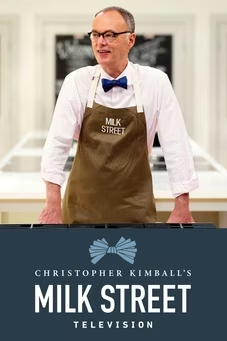
Christopher Kimball’s Milk Street Television
Transform home cooking with the editors of Christopher Kimball’s Milk Street Magazine.





Support for PBS provided by:
Dook Chase: A Chef's Journey is presented by your local public television station.